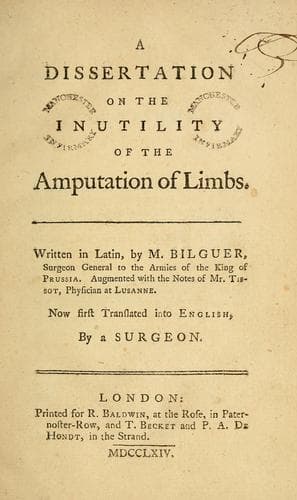
A dissertation on the inutility of the amputation of limbsBilguer, Johann Ulrich
History
A dissertation on the inutility of the amputation of limbs
Bilguer, Johann Ulrich
Amputation -- Early works to 1800
[43] See Heister's Surgery, t. i. part i. ch. 13. Edinburgh Medical
Essays, vol. ii. art. 15. vol. v. art. 17. The Promptuar. Hamburg. and
the Collections of Breslau, in several places.
[44] Anatomy, observations in surgery, and the opening of dead bodies,
concur to establish Mr. Bilguer's opinion.
The anatomical proofs are drawn from the inspection of the arteries. I
am persuaded, that unless the crural artery is wounded almost at its
egress from the arch formed by the tendons of the abdominal muscles,
where it loses the name of iliac, its being destroyed will very seldom
occasion the loss of the limb; besides three small branches which
it sends off almost at its egress, and on which, I own, should have
no great reliance, for the nourishment of so large a limb, both on
account of their smallness and their distribution, at about two or
three inches distance from the artery, it sends off other branches much
more considerable, among others, two called the muscular arteries,
especially the external one, descends pretty large down the thigh, and
very evidently contributes to the nourishment of the muscular parts;
although their trunks have not been traced so far as the leg, I make
no doubt but it may be discovered that their branches reach that part,
and which, though scarcely visible in their natural state, would not
fail to become larger, when the blood was thrown into them in greater
abundance; besides, the anastomosis of any considerable branch with
the trunk of the crural artery, conveys so much blood to it, that it
may again become useful: Experience demonstrates that this happens in
the arm, and it is highly probable that the same thing may take place
in the thigh; the number of branches which spring from the brachial
artery, almost from its beginning, and their distribution being very
analogous to what we see in the crural artery.
The surgical observations which demonstrate the recovery of heat in
the parts after the operation for the aneurism, although the brachial
artery has been tied very high, are common, and may be found among
other observators besides those quoted by Mr. Bilguer, and there are
doubtless few physicians or surgeons who have not had opportunities of
seeing such cases themselves.
It is a sight extremely interesting, to observe the gradual return of
heat, strength and colour, to an arm on which the operation for the
aneurism has been performed. I do not know that this operation was ever
performed in the thigh, the artery being so guarded in this part, that
an aneurism rarely forms here. I have seen the operation succeed very
well in the inferior part of the leg, on the tibialis anterior, and the
foot suffered but very little for a few days; it is true it is supplied
with several other branches.
Public-domain text, read in full here on John Shaqi.
Reviews
Reviews
No reviews yet
Be the first to share your thoughts on this work.
Join the Discussion
Join the discussion
Sign in to leave a comment or review.
Sign InorCreate an account