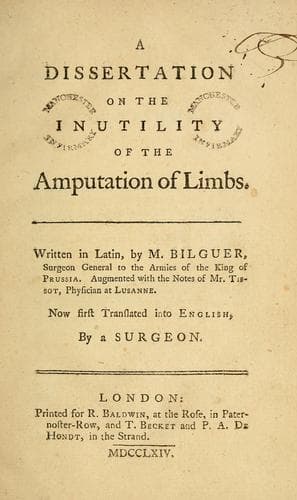
A dissertation on the inutility of the amputation of limbsBilguer, Johann Ulrich
History
A dissertation on the inutility of the amputation of limbs
Bilguer, Johann Ulrich
Amputation -- Early works to 1800
Some curious dissections of dead bodies afford a third argument, as the
crural artery has been found quite obliterated in the upper part of the
thigh, in consequence of a morbid cause, without the leg having been
deprived of its nourishment, though supplied perhaps more imperfectly.
Warm water baths, in these cases where the circulation is to be
promoted through the smaller vessels, and their diameters enlarged, are
among the most efficacious remedies. TISSOT.
[45] See § XIII.
[46] § XXXII. It is long since the bolar earths have had the reputation
of being useful in contusions, but this I am afraid is founded on a
mistake; I have never, in any case, experienced the least effect from
them that could induce me to think they possessed the virtues ascribed
to them. True bole armenic might prove somewhat astringent in the
first passages, but could not do any service in this way; or might
suffer perhaps a small portion of the vitriolic acid it contains, to
disengage itself; but four or five drops of the spirit of sulphur,
would be more useful in this respect than a dose of the bole: Thus I
am almost convinced it is of very little benefit in this composition,
and if of any, it must be by blunting the action of the neutral salts,
and preventing the uneasiness they sometimes occasion to persons of
delicate stomachs. TISSOT.
[47] I have seen an officer, a captain in the French service, who
received a musket shot, with the muzzle of the piece close to the
part; the ball shattered the humeral bone near its head, close to
the articulation: had the wound been somewhat lower, that is less
dangerous, his arm would have been taken off; the impossibility, or
the difficulty of the operation prevented it; he suffered all the
inconveniencies that a wound can occasion, for a considerable time
several splinters were extracted, at length at the end of five months
he was cured. This case appears to me of consequence, because here we
see a very bad wound of that kind for which amputation is performed
every day, and the danger aggravated by the nature of the part where
it is inflicted, where they do not amputate, because it cannot be
done, yet it was cured. If this officer had been so fortunate as to be
wounded a few inches lower, he would have had the misfortune of having
his arm taken off. TISSOT.
[48] _Fifty years_, a compliment which Mr. Bilguer pays surgeons of a
more modern date.
M. le Conte de B... a general officer in the Austrian service, received
a wound much of the same kind, at Hochirken, and had the good fortune
to be compleatly cured by M. Brunet, without amputation, which appeared
indispensably necessary. He only continued a little weak, which in a
man of his age and constitution generally goes off of itself: He was
advised to go to the baths at Baden in Austria, and on his return was
seized with an inflammatory fever, which proved mortal. TISSOT.
SECT. XXXVII.
Public-domain text, read in full here on John Shaqi.
Reviews
Reviews
No reviews yet
Be the first to share your thoughts on this work.
Join the Discussion
Join the discussion
Sign in to leave a comment or review.
Sign InorCreate an account