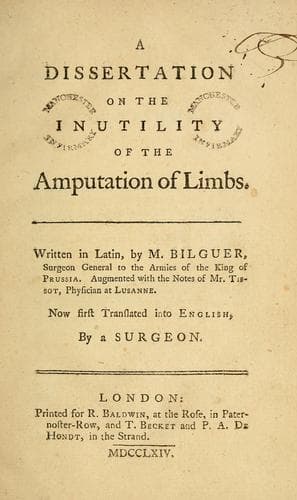
A dissertation on the inutility of the amputation of limbsBilguer, Johann Ulrich
History
A dissertation on the inutility of the amputation of limbs
Bilguer, Johann Ulrich
Amputation -- Early works to 1800
I might enumerate the cases of a great number of wounded men cured in
this way, but the instances I have mentioned may suffice to make it
known; I shall only add, that even while I am writing, there are a
great many patients in the hospitals at Torgau, whose bones were so
broken and shattered, that hitherto surgeons would not have conceived
that it was possible to cure them without amputation, and who are all
nevertheless in the way of recovery, by the method I have recommended.
There are very few surgeons of the army, who have not seen instances
in our hospitals of patients whose limbs were to have been cut off,
where to their great dread, every thing was ready, and they placed in
order to undergo the operation, when, either from their fainting or
their resistance, it has been put off, and recourse has been had to
the method I have just pointed out, by which, contrary to the general
opinion, they have been cured, have saved their limb, and used it
afterwards with convenience. If we compare this with what has been
said, § XXVII. it will readily appear, that for the most part it is
extremely wrong to amputate the limbs.
SECT. XXXVIII.
I have treated hitherto of accidents which quickly carry off the
patients; I come now to consider those where the danger is not so
pressing, and which terminate in death by slow degrees, a caries of the
bone, and a cancerous state of the parts; for it is well known, that in
these circumstances amputation is often deemed necessary.
A caries of the bone is either superficial or deep seated, recent
or inveterate, occasioned by a vicious state of the fluids, or the
consequence of some external hurt.
When it is recent and inconsiderable, whatever be the cause, there is
no room to think of amputation at all, but the bone must be laid bare
according to the extent of the caries, and scraped with a scalpel, or
perforated in sundry places with the spike of a trepan; when the caries
has gained the opposite part of the bone, we must then use the crown
of the trepan, in order to take out the entire piece. I do not however
propose entering into a detail of the manner of performing these
operations.
Public-domain text, read in full here on John Shaqi.
Reviews
Reviews
No reviews yet
Be the first to share your thoughts on this work.
Join the Discussion
Join the discussion
Sign in to leave a comment or review.
Sign InorCreate an account