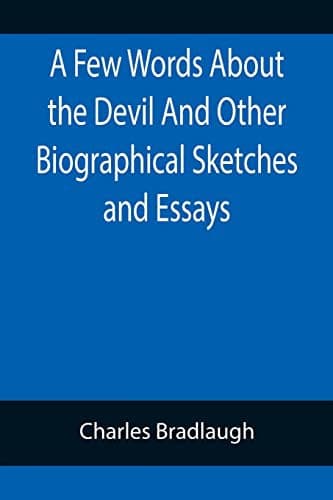
A Few Words About the Devil, and Other Biographical Sketches and EssaysBradlaugh, Charles
Religion
A Few Words About the Devil, and Other Biographical Sketches and Essays
Bradlaugh, Charles
Free thought
more claimants tor a share of the fund which has hitherto been found
insufficient to keep the working classes from death by starvation.
The object of this pamphlet will be amply attained if it serve as the
means of inducing some of the working classes to examine for themselves
the teachings of Political Economy. All that is at present needed is
that laboring men and women should be accustomed, both publicly and at
home, to the consideration and discussion of the views and principles
first openly propounded by Mr. Malthus, and since elaborated by Mr. Mill
and other writers. The mere investigation of the subject will of itself
serve to bring to the notice of the masses many facts hitherto entirely
ignored by them. All must acknowledge the terrible ills resulting from
poverty, and all therefore are bound to use their faculties to discover
if possible its cause and cure. It is more than folly for the working
man to permit himself to be turned away from the subject by the cry
that the Political Economists have no sympathy with the poor. If
the allegation were true, which it is not, it would only afford an
additional reason why this important science should find students among
those who most need aid from its teachings.
THE LAND QUESTION.
LARGE ESTATES INIMICAL TO THE WELFARE OF THE PEOPLE
Property in land differs from ordinary property. Wealth, which is the
accumulated result of labor, is sometimes, but not often, accumulated
in the hands of the laborer, and is more frequently accumulated in the
hands of some person who has purchased the result of the laborers
toil. Such personal wealth is capable of indefinite increase; and
the exclusive right to its disposal is protected in the hands of its
possessor, so long as he does not avail himself of this legal protection
to use the wealth mischievously to his fellows. There would be no
incentive in the laborer to economy, or to increased exertion, unless
the State gave him reasonable protection in the enjoyment of his
savings. Unfortunately, to obtain the protection of the authorities,
he has in this country to give up an unreasonably large portion of his
earnings to defray the cost of local and imperial Government. During the
reign of her present Majesty, imperial taxation alone has increased from
about £48,000,000 to £73,833,000. The State has no right to interfere
with a man's daily disposition of his personal wealth, merely on the
ground that he might have used it more advantageously for his fellows.
With land it is quite different; it is limited in extent, and the
portions of it capable of producing food with ease to the cultivator are
still more limited. Every individual member of the commonwealth has an
indefeasible interest in the totality of the land, and no man ought
to assert an absolute freehold in land hostile to the interest of his
fellow. The land is part of the general soil of the State, and should be
held subject to the general welfare of the citizens. No man has a right
Public-domain text, read in full here on John Shaqi.
Reviews
Reviews
No reviews yet
Be the first to share your thoughts on this work.
Elsewhere in the archive
Join the Discussion
Join the discussion
Sign in to leave a comment or review.
Sign InorCreate an account