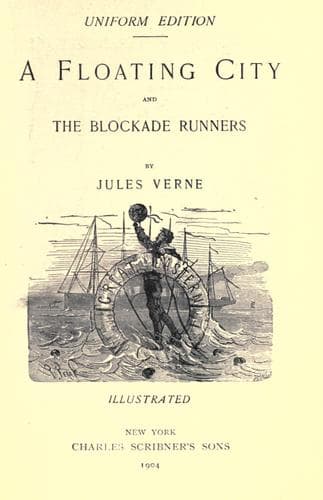
A Floating City, and The Blockade RunnersVerne, Jules
History
A Floating City, and The Blockade Runners
Verne, Jules
Great Eastern (Steamship) -- Fiction; United States -- History -- Civil War, 1861-1865 -- Blockades -- Fiction
But if James Playfair had been pleased with his ship, he had not been
less delighted with the young girl’s bravery; Miss Halliburtt had passed
the worst hours of the storm at his side, and James knew that a
profound, imperious, irresistible love had taken possession of his whole
being.
“Yes,” said he, “this brave girl is mistress on board; she turns me like
the sea a ship in distress—I feel that I am foundering! What will Uncle
Vincent say? Ah! poor nature, I am sure that if Jenny asked me to throw
all this cursed cargo into the sea, I should do it without hesitating,
for love of her.”
Happily for the firm of Playfair and Co., Miss Halliburtt did not demand
this sacrifice; nevertheless, the poor Captain had been taken captive,
and Crockston, who read his heart like an open book, rubbed his hands
gleefully.
“We will hold him fast!” he muttered to himself, “and before a week has
passed my master will be quietly installed in one of the best cabins of
the ‘Dolphin.’”
As for Miss Jenny, did she perceive the feelings which she inspired? did
she allow herself to share them? No one could say, and James Playfair
least of all; the young girl kept a perfect reserve, and her secret
remained deeply buried in her heart.
But whilst love was making such progress in the heart of the young
Captain, the “Dolphin” sped with no less rapidity towards Charleston.
On the 13th of January, the watch signalled land ten miles to the west.
It was a low-lying coast, and almost blended with the line of the sea in
the distance. Crockston was examining the horizon attentively, and about
nine o’clock in the morning he cried,—
“Charleston lighthouse!”
[Illustration: CROCKSTON WAS EXAMINING THE HORIZON ATTENTIVELY.]
Now that the bearings of the “Dolphin” were set, James Playfair had but
one thing to do, to decide by which channel he would run into Charleston
Bay.
“If we meet with no obstacles,” said he, “before three o’clock we shall
be in safety in the docks of the port.”
The town of Charleston is situated on the banks of an estuary seven
miles long and two broad, called Charleston Harbour, the entrance to
which is rather difficult. It is enclosed between Morris Island on the
south, and Sullivan Island on the north. At the time when the “Dolphin”
attempted to force the blockade Morris Island already belonged to the
Federal troops, and General Gillmore had caused batteries to be erected
overlooking the harbour. Sullivan Island, on the contrary, was in the
hands of the Confederates, who were also in possession of Moultrie Fort,
situated at the extremity of the island; therefore it would be
advantageous to the “Dolphin” to go as close as possible to the northern
shores to avoid the firing from the forts on Morris Island.
Public-domain text, read in full here on John Shaqi.
Reviews
Reviews
No reviews yet
Be the first to share your thoughts on this work.
Elsewhere in the archive
Join the Discussion
Join the discussion
Sign in to leave a comment or review.
Sign InorCreate an account