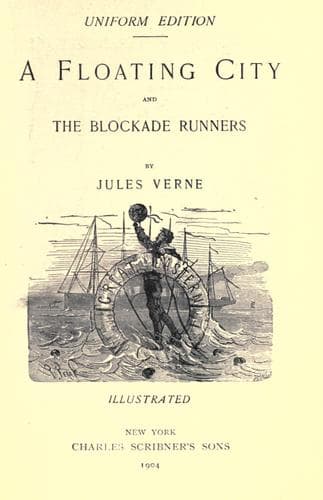
A Floating City, and The Blockade RunnersVerne, Jules
History
A Floating City, and The Blockade Runners
Verne, Jules
Great Eastern (Steamship) -- Fiction; United States -- History -- Civil War, 1861-1865 -- Blockades -- Fiction
The last rays of the setting sun had disappeared behind the grey hills,
and the moon shed her soft clear light over the landscape. The shadow of
the tower stretched across the abyss; farther down the stream the water
glided silently along, crowned with a light mist. The Canadian shore,
already plunged in darkness, contrasted vividly with the moon-lit banks
of Goat Island, and the village of Niagara Falls. Below us, the gulf,
magnified by the uncertain light, looked like a bottomless abyss, in
which roared the formidable torrent. What effect! What artist could ever
depict such a scene, either with the pen or paint-brush? For some
minutes a moving light appeared on the horizon; it was the signal light
of a train crossing the Niagara bridge at a distance of two miles from
us. Here we remained silent and motionless on the top of the tower until
midnight, leaning over the waters which possessed such a fascination.
Once, when the moon-beams caught the liquid dust at a certain angle, I
had a glimpse of a milky band of transparent ribbon trembling in the
shadows. It was a lunar rainbow, a pale irradiation of the queen of the
night, whose soft light was refracted through the mist of the cataract.
CHAPTER XXXVIII.
The next day, the 13th of April, the Doctor’s programme announced a
visit to the Canadian shore. We had only to follow the heights of the
bank of the Niagara for two miles to reach the suspension bridge. We
started at seven o’clock in the morning. From the winding path on the
right bank we could see the tranquil waters of the river, which no
longer felt the perturbation of its fall.
At half-past seven we reached the suspension bridge. It is the bridge,
on which the Great Western and New York Central Railroads meet, and the
only one which gives access to Canada on the confines of the State of
New York. This suspension bridge is formed of two platforms; the upper
one for trains, and the lower for carriages and pedestrians. Imagination
seems to lose itself in contemplating this stupendous work. This
viaduct, over which trains can pass, suspended at a height of two
hundred and fifty feet above the Niagara, again transformed into a rapid
at this spot. This suspension bridge, built by John A. Roebling, of
Trenton (New Jersey), is eight hundred feet long, and twenty-four wide;
the iron props fastened to the shore prevent it from swinging; the
chains which support it, formed of four thousand wires, are ten inches
in diameter, and can bear a weight of twelve thousand four hundred tons.
The bridge itself weighs but eight hundred tons, and cost five hundred
thousand dollars. Just as we reached the centre a train passed over our
heads, and we felt the platform bend under its weight.
Public-domain text, read in full here on John Shaqi.
Reviews
Reviews
No reviews yet
Be the first to share your thoughts on this work.
Elsewhere in the archive
Join the Discussion
Join the discussion
Sign in to leave a comment or review.
Sign InorCreate an account