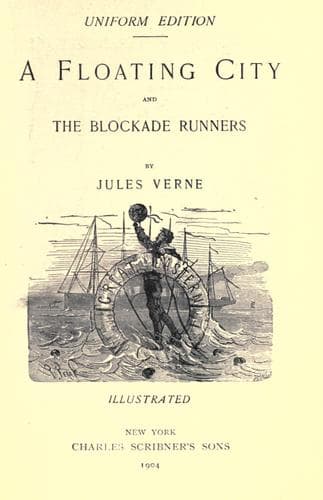
A Floating City, and The Blockade RunnersVerne, Jules
History
A Floating City, and The Blockade Runners
Verne, Jules
Great Eastern (Steamship) -- Fiction; United States -- History -- Civil War, 1861-1865 -- Blockades -- Fiction
[Illustration: AND SOON DISAPPEARED.]
The descent of the Clyde was easily accomplished, one might almost say
that this river had been made by the hand of man, and even by the hand
of a master. For sixty years, thanks to the dredges and constant
dragging it has gained fifteen feet in depth, and its breadth has been
tripled between the quays and the town. Soon the forests of masts and
chimneys were lost in the smoke and fog; the noise of the foundry
hammers, and the hatchets of the timber-yards grew fainter in the
distance. After the village of Patrick had been passed the factories
gave way to country houses and villas. The “Dolphin,” slackening her
speed, sailed between the dykes which carry the river above the shores,
and often through very narrow channel, which, however, is only a small
inconvenience for a navigable river, for, after all, depth is of more
importance than width. The steamer, guided by one of those excellent
pilots from the Irish sea, passed without hesitation between floating
buoys, stone columns, and _biggings_, surmounted with lighthouses, which
mark the entrance to the channel. Beyond the town of Renfrew, at the
foot of Kilpatrick hills, the Clyde grew wider. Then came Bouling Bay,
at the end of which opens the mouth of the canal which joins Edinburgh
to Glasgow. Lastly, at the height of four hundred feet from the ground,
was seen the outline of Dumbarton Castle, almost indiscernible through
the mists, and soon the harbour-boats of Glasgow were rocked on the
waves which the “Dolphin” caused. Some miles farther on Greenock, the
birthplace of James Watt, was passed: the “Dolphin” now found herself at
the mouth of the Clyde, and at the entrance of the gulf by which it
empties its waters into the Northern Ocean. Here the first undulations
of the sea were felt, and the steamer ranged along the picturesque coast
of the Isle of Arran. At last the promontory of Cantyre, which runs out
into the channel, was doubled; the Isle of Rattelin was hailed, the
pilot returned by a shore-boat to his cutter, which was cruising in the
open sea; the “Dolphin” returning to her Captain’s authority, took a
less frequented route round the north of Ireland, and soon, having lost
sight of the last European land, found herself in the open ocean.
CHAPTER III.
The “Dolphin” had a good crew, not fighting men, or boarding sailors,
but good working men, and that was all she wanted. These brave,
determined fellows were all, more or less, merchants; they sought a
fortune rather than glory; they had no flag to display, no colours to
defend with cannon; in fact all the artillery on board consisted of two
small swivel signal-guns.
Public-domain text, read in full here on John Shaqi.
Reviews
Reviews
No reviews yet
Be the first to share your thoughts on this work.
Elsewhere in the archive
Join the Discussion
Join the discussion
Sign in to leave a comment or review.
Sign InorCreate an account