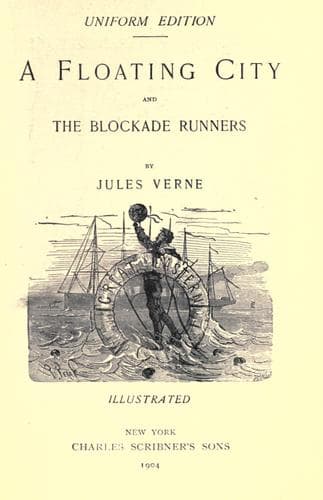
A Floating City, and The Blockade RunnersVerne, Jules
History
A Floating City, and The Blockade Runners
Verne, Jules
Great Eastern (Steamship) -- Fiction; United States -- History -- Civil War, 1861-1865 -- Blockades -- Fiction
“Who are you? An American, as these letters seem to prove?”
Crockston did not answer.
“Boatswain,” said James Playfair, “fifty lashes with the
cat-o’-nine-tails to loosen his tongue. Will that be enough, Crockston?”
“It will remain to be seen,” replied John Stiggs’ uncle without moving a
muscle.
“Now then, come along, men,” said the boatswain.
At this order, two strong sailors stripped Crockston of his woollen
jersey; they had already seized the formidable weapon, and laid it
across the prisoner’s shoulders, when the novice, John Stiggs, pale and
agitated, hurried on deck.
“Captain!” exclaimed he.
“Ah! the nephew!” remarked James Playfair.
“Captain,” repeated the novice, with a violent effort to steady his
voice, “I will tell you what Crockston does not want to say. I will hide
it no longer; yes, he is American, and so am I; we are both enemies of
the slave-holders, but not traitors come on board to betray the
‘Dolphin’ into the hands of the Federalists.”
“What did you come to do, then?” asked the Captain, in a severe tone,
examining the novice attentively. The latter hesitated a few seconds
before replying, then he said, “Captain, I should like to speak to you
in private.”
[Illustration: “CAPTAIN!” EXCLAIMED HE.]
Whilst John Stiggs made this request, James Playfair did not cease to
look carefully at him; the sweet young face of the novice, his
peculiarly gentle voice, the delicacy and whiteness of his hands, hardly
disguised by paint, the large eyes, the animation of which could not
hide their tenderness—all this together gave rise to a certain suspicion
in the Captain’s mind. When John Stiggs had made his request, Playfair
glanced fixedly at Crockston, who shrugged his shoulders; then he
fastened a questioning look on the novice, which the latter could not
withstand, and said simply to him, “Come.”
John Stiggs followed the Captain on to the poop, and then James
Playfair, opening the door of his cabin, said to the novice, whose
cheeks were pale with emotion, “Be so kind as to walk in, miss.”
John, thus addressed, blushed violently, and two tears rolled
involuntarily down his cheeks.
“Don’t be alarmed, miss,” said James Playfair, in a gentle voice, “but
be so good as to tell me how I come to have the honour of having you on
board?”
The young girl hesitated a moment, then reassured by the Captain’s look,
she made up her mind to speak.
“Sir,” said she, “I wanted to join my father at Charleston; the town is
besieged by land and blockaded by sea. I knew not how to get there, when
I heard that the ‘Dolphin’ meant to force the blockade. I came on board
your ship, and I beg you to forgive me if I acted without your consent,
which you would have refused me.”
“Certainly,” said James Playfair.
“I did well, then, not to ask you,” resumed the young girl, with a
firmer voice.
The Captain crossed his arms, walked round his cabin, and then came
back.
“What is your name?” said he.
“Jenny Halliburtt.”
Public-domain text, read in full here on John Shaqi.
Reviews
Reviews
No reviews yet
Be the first to share your thoughts on this work.
Elsewhere in the archive
Join the Discussion
Join the discussion
Sign in to leave a comment or review.
Sign InorCreate an account