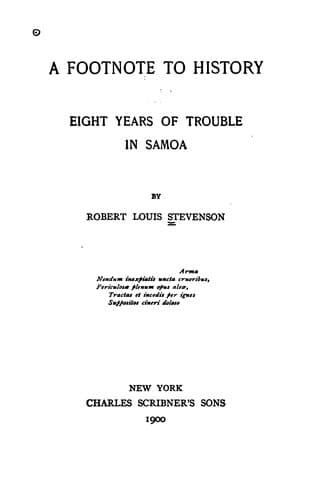
A Footnote to History: Eight Years of Trouble in SamoaStevenson, Robert Louis
History
A Footnote to History: Eight Years of Trouble in Samoa
Stevenson, Robert Louis
Samoan Islands -- History
delightfully amusing. The champions asked for the English printer. They
were shown the wrong man, and the blows intended for Cusack had hailed on
the shoulders of his rival Jones. On the 12th, Cusack had reprinted an
article from a San Francisco paper; the Germans had complained; and de
Coetlogon, in a moment of weakness, had fined the editor twenty pounds.
The judgment was afterwards reversed in Fiji; but even at the time it had
not satisfied the Germans. And so now, on the third day of martial law,
the paper was suppressed. Here we have another of these international
obscurities. To Fritze the step seemed natural and obvious; for Anglo-
Saxons it was a hand laid upon the altar; and the month was scarce out
before the voice of Senator Frye announced to his colleagues that free
speech had been suppressed in Samoa.
Perhaps we must seek some similar explanation for Fritze's short-lived
code, published and withdrawn the next day, the 23rd. Fritze himself was
in no humour for extremities. He was much in the position of a
lieutenant who should perceive his captain urging the ship upon the
rocks. It is plain he had lost all confidence in his commanding officer
"upon the legal side"; and we find him writing home with anxious candour.
He had understood that martial law implied military possession; he was in
military possession of nothing but his ship, and shrewdly suspected that
his martial jurisdiction should be confined within the same limits. "As
a matter of fact," he writes, "we do not occupy the territory, and cannot
give foreigners the necessary protection, because Mataafa and his people
can at any moment forcibly interrupt me in my jurisdiction." Yet in the
eyes of Anglo-Saxons the severity of his code appeared burlesque. I give
but three of its provisions. The crime of inciting German troops "by any
means, as, for instance, informing them of proclamations by the enemy,"
was punishable with death; that of "publishing or secretly distributing
anything, whether printed or written, bearing on the war," with prison or
deportation; and that of calling or attending a public meeting, unless
permitted, with the same. Such were the tender mercies of Knappe,
lurking in the western end of the German quarter, where Mataafa could "at
any moment" interrupt his jurisdiction.
Public-domain text, read in full here on John Shaqi.
Reviews
Reviews
No reviews yet
Be the first to share your thoughts on this work.
Elsewhere in the archive
Join the Discussion
Join the discussion
Sign in to leave a comment or review.
Sign InorCreate an account