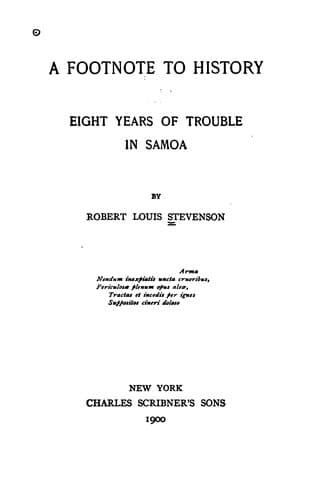
A Footnote to History: Eight Years of Trouble in SamoaStevenson, Robert Louis
History
A Footnote to History: Eight Years of Trouble in Samoa
Stevenson, Robert Louis
Samoan Islands -- History
"I will make you a present of the three."
The crews of the American and German squadrons were now cast, still in a
bellicose temper, together on the beach. The discipline of the Americans
was notoriously loose; the crew of the _Nipsic_ had earned a character
for lawlessness in other ports; and recourse was had to stringent and
indeed extraordinary measures. The town was divided in two camps, to
which the different nationalities were confined. Kimberley had his
quarter sentinelled and patrolled. Any seaman disregarding a challenge
was to be shot dead; any tavern-keeper who sold spirits to an American
sailor was to have his tavern broken and his stock destroyed. Many of
the publicans were German; and Knappe, having narrated these rigorous but
necessary dispositions, wonders (grinning to himself over his despatch)
how far these Americans will go in their assumption of jurisdiction over
Germans. Such as they were, the measures were successful. The
incongruous mass of castaways was kept in peace, and at last shipped in
peace out of the islands.
Kane returned to Apia on the 19th, to find the _Calliope_ the sole
survivor of thirteen sail. He thanked his men, and in particular the
engineers, in a speech of unusual feeling and beauty, of which one who
was present remarked to another, as they left the ship, "This has been a
means of grace." Nor did he forget to thank and compliment the admiral;
and I cannot deny myself the pleasure of transcribing from Kimberley's
reply some generous and engaging words. "My dear captain," he wrote,
"your kind note received. You went out splendidly, and we all felt from
our hearts for you, and our cheers came with sincerity and admiration for
the able manner in which you handled your ship. We could not have been
gladder if it had been one of our ships, for in a time like that I can
truly say with old Admiral Josiah Latnall, 'that blood is thicker than
water.'" One more trait will serve to build up the image of this typical
sea-officer. A tiny schooner, the _Equator_, Captain Edwin Reid, dear to
myself from the memories of a six months' cruise, lived out upon the high
seas the fury of that tempest which had piled with wrecks the harbour of
Apia, found a refuge in Pango-Pango, and arrived at last in the desolated
port with a welcome and lucrative cargo of pigs. The admiral was glad to
have the pigs; but what most delighted the man's noble and childish soul,
was to see once more afloat the colours of his country.
Public-domain text, read in full here on John Shaqi.
Reviews
Reviews
No reviews yet
Be the first to share your thoughts on this work.
Elsewhere in the archive
Join the Discussion
Join the discussion
Sign in to leave a comment or review.
Sign InorCreate an account