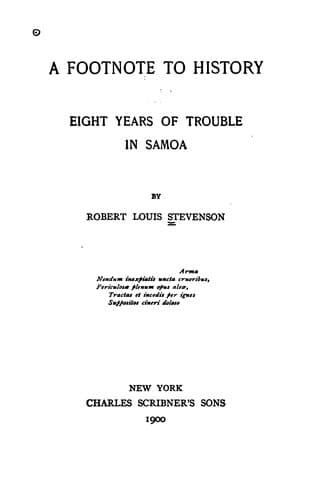
A Footnote to History: Eight Years of Trouble in SamoaStevenson, Robert Louis
History
A Footnote to History: Eight Years of Trouble in Samoa
Stevenson, Robert Louis
Samoan Islands -- History
In the Berlin Act, the three Powers recognise, on the threshold, "the
independence of the Samoan government, and the free right of the natives
to elect their chief or king and choose their form of government." True,
the text continues that, "in view of the difficulties that surround an
election in the present disordered condition of the government," Malietoa
Laupepa shall be recognised as king, "unless the three Powers shall by
common accord otherwise declare." But perhaps few natives have followed
it so far, and even those who have, were possibly all cast abroad again
by the next clause: "and his successor shall be duly elected according to
the laws and customs of Samoa." The right to elect, freely given in one
sentence, was suspended in the next, and a line or so further on appeared
to be reconveyed by a side-wind. The reason offered for suspension was
ludicrously false; in May 1889, when Sir Edward Malet moved the matter in
the conference, the election of Mataafa was not only certain to have been
peaceful, it could not have been opposed; and behind the English puppet
it was easy to suspect the hand of Germany. No one is more swift to
smell trickery than a Samoan; and the thought, that, under the long,
bland, benevolent sentences of the Berlin Act, some trickery lay lurking,
filled him with the breath of opposition. Laupepa seems never to have
been a popular king. Mataafa, on the other hand, holds an unrivalled
position in the eyes of his fellow-countrymen; he was the hero of the
war, he had lain with them in the bush, he had borne the heat and burthen
of the day; they began to claim that he should enjoy more largely the
fruits of victory; his exclusion was believed to be a stroke of German
vengeance, his elevation to the kingship was looked for as the fitting
crown and copestone of the Samoan triumph; and but a little after the
coming of the chief justice, an ominous cry for Mataafa began to arise in
the islands. It is difficult to see what that official could have done
but what he did. He was loyal, as in duty bound, to the treaty and to
Laupepa; and when the orators of the important and unruly islet of Manono
demanded to his face a change of kings, he had no choice but to refuse
them, and (his reproof being unheeded) to suspend the meeting. Whether
by any neglect of his own or the mere force of circumstance, he failed,
however, to secure the sympathy, failed even to gain the confidence, of
Mataafa. The latter is not without a sense of his own abilities or of
the great service he has rendered to his native land. He felt himself
neglected; at the very moment when the cry for his elevation rang
throughout the group he thought himself made little of on Mulinuu; and he
began to weary of his part. In this humour, he was exposed to a
temptation which I must try to explain, as best I may be able, to
Europeans.
Public-domain text, read in full here on John Shaqi.
Reviews
Reviews
No reviews yet
Be the first to share your thoughts on this work.
Elsewhere in the archive
Join the Discussion
Join the discussion
Sign in to leave a comment or review.
Sign InorCreate an account