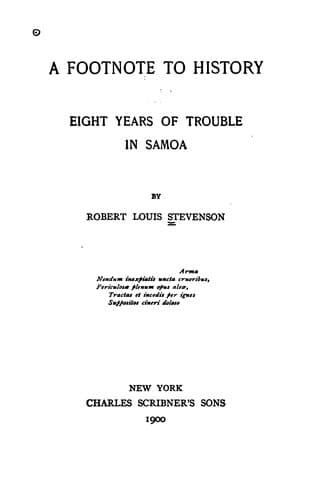
A Footnote to History: Eight Years of Trouble in SamoaStevenson, Robert Louis
History
A Footnote to History: Eight Years of Trouble in Samoa
Stevenson, Robert Louis
Samoan Islands -- History
was certainly well devised; the government escaped from their own false
position, and by the same stroke lowered the prestige of their
adversaries. But unhappily the chief justice did not put all his eggs in
one basket. Concurrently with these negotiations he began again to move
the captain of one of the war-ships to shell the rebel village; the
captain, conceiving the extremity wholly unjustified, not only refused
these instances, but more or less publicly complained of their being
made; the matter came to the knowledge of the white resident who was at
that time playing the part of intermediary with Malie; and he, in natural
anger and disgust, withdrew from the negotiation. These duplicities,
always deplorable when discovered, are never more fatal than with men
imperfectly civilised. Almost incapable of truth themselves, they
cherish a particular score of the same fault in whites. And Mataafa is
besides an exceptional native. I would scarce dare say of any Samoan
that he is truthful, though I seem to have encountered the phenomenon;
but I must say of Mataafa that he seems distinctly and consistently
averse to lying.
For the affair of the Manono prisoners, the chief justice is only again
in so far answerable as he was at the moment absent from the seat of his
duties; and the blame falls on Baron Senfft von Pilsach, president of the
municipal council. There were in Manono certain dissidents, loyal to
Laupepa. Being Manono people, I daresay they were very annoying to their
neighbours; the majority, as they belonged to the same island, were the
more impatient; and one fine day fell upon and destroyed the houses and
harvests of the dissidents "according to the laws and customs of Samoa."
The president went down to the unruly island in a war-ship and was landed
alone upon the beach. To one so much a stranger to the mansuetude of
Polynesians, this must have seemed an act of desperation; and the baron's
gallantry met with a deserved success. The six ringleaders, acting in
Mataafa's interest, had been guilty of a delict; with Mataafa's approval,
they delivered themselves over to be tried. On Friday, September 4,
1891, they were convicted before a native magistrate and sentenced to six
months' imprisonment; or, I should rather say, detention; for it was
expressly directed that they were to be used as gentlemen and not as
prisoners, that the door was to stand open, and that all their wishes
should be gratified. This extraordinary sentence fell upon the accused
like a thunderbolt. There is no need to suppose perfidy, where a
careless interpreter suffices to explain all; but the six chiefs claim to
have understood their coming to Apia as an act of submission merely
formal, that they came in fact under an implied indemnity, and that the
president stood pledged to see them scatheless. Already, on their way
from the court-house, they were tumultuously surrounded by friends and
Public-domain text, read in full here on John Shaqi.
Reviews
Reviews
No reviews yet
Be the first to share your thoughts on this work.
Elsewhere in the archive
Join the Discussion
Join the discussion
Sign in to leave a comment or review.
Sign InorCreate an account