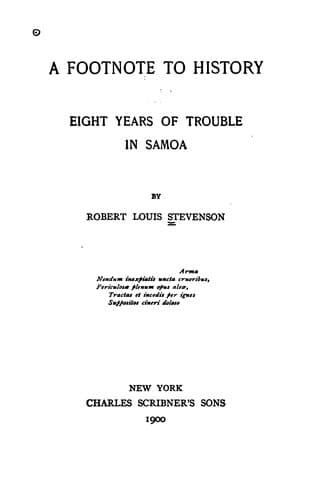
A Footnote to History: Eight Years of Trouble in SamoaStevenson, Robert Louis
History
A Footnote to History: Eight Years of Trouble in Samoa
Stevenson, Robert Louis
Samoan Islands -- History
This deplorable state of affairs was brought to an end by the departure
from Samoa of the Natives' Advocate. He was succeeded _pro tempore_ by a
young New Zealander, E. W. Gurr, not much more versed in law than
himself, and very much less so in Samoan. Whether by more skill or
better fortune, Gurr has been able in the course of a few weeks to
recover for the natives several important tracts of land; and the
prejudice against the Commission seems to be abating as fast as it arose.
I should not omit to say that, in the eagerness of the original advocate,
there was much that was amiable; nor must I fail to point out how much
there was of blindness. Fired by the ardour of pursuit, he seems to have
regarded his immediate clients as the only natives extant and the epitome
and emblem of the Samoan race. Thus, in the case that was the most
exclaimed against as "an injustice to natives," his client, Puaauli, was
certainly nonsuited. But in that intricate affair who lost the money?
The German firm. And who got the land? Other natives. To twist such a
decision into evidence, either of a prejudice against Samoans or a
partiality to whites, is to keep one eye shut and have the other
bandaged.
And lastly, one word as to the future. Laupepa and Mataafa stand over
against each other, rivals with no third competitor. They may be said to
hold the great name of Malietoa in commission; each has borne the style,
each exercised the authority, of a Samoan king; one is secure of the
small but compact and fervent following of the Catholics, the other has
the sympathies of a large part of the Protestant majority, and upon any
sign of Catholic aggression would have more. With men so nearly
balanced, it may be asked whether a prolonged successful exercise of
power be possible for either. In the case of the feeble Laupepa, it is
certainly not; we have the proof before us. Nor do I think we should
judge, from what we see to-day, that it would be possible, or would
continue to be possible, even for the kingly Mataafa. It is always the
easier game to be in opposition. The tale of David and Saul would
infallibly be re-enacted; once more we shall have two kings in the
land,--the latent and the patent; and the house of the first will become
once more the resort of "every one that is in distress, and every one
that is in debt, and every one that is discontented." Against such odds
it is my fear that Mataafa might contend in vain; it is beyond the bounds
of my imagination that Laupepa should contend at all. Foreign ships and
bayonets is the cure proposed in Mulinuu. And certainly, if people at
home desire that money should be thrown away and blood shed in Samoa, an
effect of a kind, and for the time, may be produced. Its nature and
prospective durability I will ask readers of this volume to forecast for
themselves. There is one way to peace and unity: that Laupepa and
Mataafa should be again conjoined on the best terms procurable. There
Public-domain text, read in full here on John Shaqi.
Reviews
Reviews
No reviews yet
Be the first to share your thoughts on this work.
Elsewhere in the archive
Join the Discussion
Join the discussion
Sign in to leave a comment or review.
Sign InorCreate an account