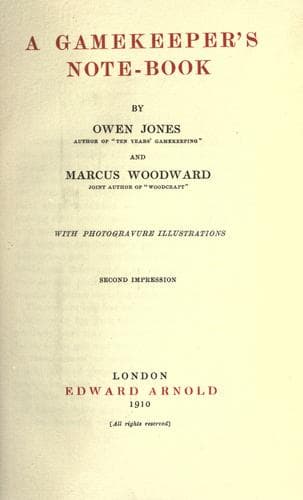
Game and game-birds -- Great Britain; Gamekeepers -- Great Britain; Natural history -- Great Britain
At a Boxing Day shooting-lunch the talk among the guns was upon the
ways and wiles of woodcock. One spoke of his long bill, with its
sensitive nerves, which tell the bird what he has found when the
bill forages among the dead leaves; speculating as to whether he
lived by his powers of suction only. Another wondered if the eating
qualities of woodcock legs were really improved by pulling out the
sinews. The question arose: Is the man who shoots a woodcock entitled
to its pen-feathers, or is the man who first finds and secures those
delicate trophies best entitled to stick them in the band of his hat?
Woodcock provoked many controversies. Is there any secret in the proper
roasting of them? Would the law absolve a man who shot his fellow when
shooting 'cock?--and would the fact that he shot his bird as well
as his man make any difference? How many people could swear to have
seen the mother woodcock carrying her young; and exactly how does
she carry them? How many of the home-bred birds leave us in autumn?
What proportion of woodcock comes in from abroad, and what is the
difference between the foreigners and the genuine Britishers? In answer
to the last question, a suggestion was made that the foreign birds
were large and light in colour, but the British birds small and dark.
Around this point arose a discussion, and the keeper was called in to
give his opinion. "It ain't nothin' at all to do with Englishmen and
foreigners," he said. "It be whether they be cocks or hens, and 'tis
the large light uns that be the hens."
* * * * *
Spare the Hens
Most gamekeepers hold the killing of a hen pheasant after Christmas
to be a moral crime. And perhaps most genuine sportsmen feel a twinge
of the conscience when they pull a trigger at a hen in New Year
days--irrespective of the host's permission. Of course, when the orders
are to spare hens, the man who kills or even tries to kill one does
something that the keeper will not forget--he loses caste for ever in
the keeper's eyes; whereas the man who is not greedy to take advantage
of an impromptu permission to shoot hens ensures for himself a niche in
the keeper's good graces.
It is true, there are hens and hens. Only a churlish keeper would not
admire the man who stops one of those skyscraping hens, of the sort
bagged by ordinary gunners about once in a lifetime. But the order,
"Shoot hens if they are real tall ones," alarms a keeper--unless he has
full confidence in the guns of a party. When the word has been given,
it is wonderful how many hens are "real tall ones." There are excuses
which must be accepted: for in certain conditions of light, when the
golden moment for pressing the trigger is within grasp, it is almost
impossible to distinguish hens from cocks--length of tail is then the
most reliable evidence.
Public-domain text, read in full here on John Shaqi.
Reviews
Reviews
No reviews yet
Be the first to share your thoughts on this work.
Elsewhere in the archive
Join the Discussion
Join the discussion
Sign in to leave a comment or review.
Sign InorCreate an account