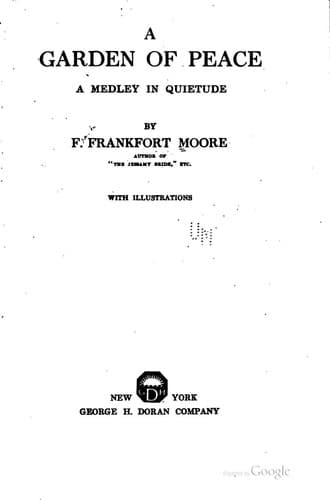
A Garden of Peace: A Medley in QuietudeMoore, Frank Frankfort
General
A Garden of Peace: A Medley in Quietude
Moore, Frank Frankfort
Gardens -- Fiction
I should like also to write something scathing about the superior person
who sneers at what I have heard called “Gin Palace Art.” This person
is ready to condemn unreservedly the association of art with the
public-house, the hotel, and even the tea-room. Now, considering the
recent slump in real palaces--the bishops have begun calling their
palaces houses--I think that some gratitude should be shown to those
licensed persons who so amply recognise the fact that upon them devolves
the responsibility of carrying on the tradition of the Palace. Long ago,
in the days when there were real Emperors and Kings and Popes, it was
an understood thing that a Royal Residence should be a depository of all
the arts, and in every country except England, this assumption was nobly
acted upon. If it had not been for the magnificent patronage--that is
the right word, for it means protection--of many arts by the Church and
by the State of many countries, we should know very little about the
arts to-day. But when the men of many licences had the name “gin-palace”
given to their edifices--it was given to them in the same spirit of
obloquy as animated the scoffers of Antioch when they invented the name
“Christian”--they nobly resolved to act as the Christians did, by trying
to live up to their new name. We see how far success has crowned their
resolution. The representative hostelries of these days go beyond the
traditional king's house which was all glorious within--they are all
glorious--so far as is consistent with educated taste--as to their
exterior as well. A “tied house” really means nowadays one that is tied
down to the resolution that the best traditions of the palace shall be
maintained.
Let any one who can remember what the hotels and public-houses and
eating-houses of forty years ago were like, say if the change that has
been brought about is not an improvement that may be considered almost
miraculous. In the old days when a man left the zinc counters of one
of these places of refreshment, he was usually in a condition that was
alluded to euphemistically as “elevated but nowadays the man who pays a
visit to a properly equipped tavern is elevated in no euphemistic sense.
I remember the cockroaches of the old Albion--they were so tame that
they would eat out of your hand. But if they did, the _habitués_ of that
tavern had their revenge: some of these expert gastronomes professed
to be able to tell from the flavour of the soup whether it had been
seasoned with the cockroaches of the table or the black beetles of the
kitchen.
“What do you mean, sir?” cried an indignant diner to the waiter--“I
ordered portions for three, and yet there are only two cockroaches.”
I recollect in the old days of The Cock tavern in Fleet Street it was
said when the report was circulated that it was enlarging its borders,
that the name on the sign should be appropriately enlarged from the Cock
to the Cockroach.
Public-domain text, read in full here on John Shaqi.
Reviews
Reviews
No reviews yet
Be the first to share your thoughts on this work.
Elsewhere in the archive
Join the Discussion
Join the discussion
Sign in to leave a comment or review.
Sign InorCreate an account