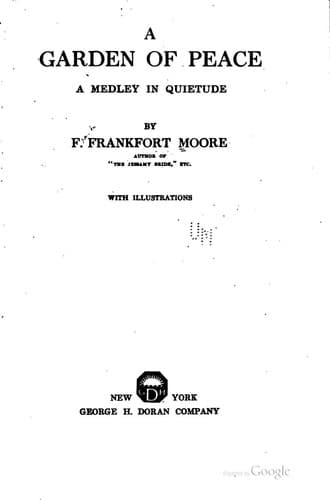
A Garden of Peace: A Medley in QuietudeMoore, Frank Frankfort
General
A Garden of Peace: A Medley in Quietude
Moore, Frank Frankfort
Gardens -- Fiction
Again may I beg leave to express the opinion that there is no need for
any one to depend upon conventional ornaments with a view to make the
garden interesting as well as ornamental. With a little imagination,
one can introduce quite a number of details that are absolutely unique.
There is nothing that looks better than an arch made out of an old stone
doorway. It may be surmounted by a properly supported shield carved with
a crest or a monogram. A rose pillar of stone has a charming appearance
at the end of a vista. The most effective I have seen were made of
artificial stone, and they cost very little. Many of the finest garden
figures of the eighteenth century were made of this kind of cement,
only inferior in many respects to the modern “artificial stone.” It is
unnecessary to say that any material that resists frost will survive
that comparatively soft stone work which goes from bad to worse year by
year in the open.
But I do not think that, while great freedom and independence should be
shown in the introduction of ornamental work, one should ever go so far
as to construct in cold blood a ruin of any sort, nor is there any need,
I think, to try to make a new piece look antique.
But I have actually known of a figure being deprived of one of its
arms in order to increase its resemblance to the Venus of the island
of Milos! Such mutilation is unwarrantable. I have known of Doctors of
Medicine taking pains to make their heads bald, in compliance with the
decrepit notion that knowledge was inseparable from a venerable age.
There may be an excuse for such a proceeding, though to my mind this
posturing lacks only two letters to be imposturing; but no excuse can
be found for breaking the corner off a piece of moulding or for treating
a stone figure with chemicals in order to suggest antiquity. Such
dealers as possess a clientele worth maintaining, know that a thing “in
mint condition,” as they describe it, is worth more than a similar
thing that is deficient in any way. That old story about the artificial
worm-eating will not be credited by any one who is aware of the fact
that a piece of woodwork showing signs of the ravages of the wood moth
is practically worthless. There would be some sense in a story of a man
coming to a dealer with a composition to prevent worm-holes, as they are
called, being recognised. Ten thousand pounds would not be too much to
pay for a discovery that would prevent woodwork from being devoured by
this abominable thing. Surely some of the Pasteur professors should be
equal to the task of producing a serum by which living timber might be
inoculated so as to make it immune to such attacks, or liable only to
the disease in a mild form.
Public-domain text, read in full here on John Shaqi.
Reviews
Reviews
No reviews yet
Be the first to share your thoughts on this work.
Elsewhere in the archive
Join the Discussion
Join the discussion
Sign in to leave a comment or review.
Sign InorCreate an account