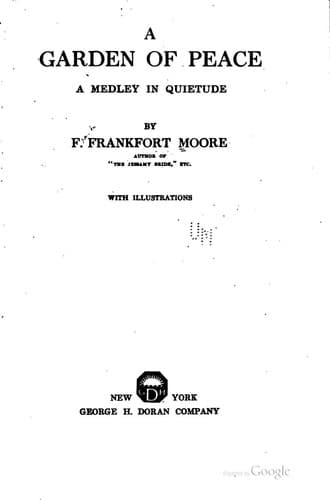
A Garden of Peace: A Medley in QuietudeMoore, Frank Frankfort
General
A Garden of Peace: A Medley in Quietude
Moore, Frank Frankfort
Gardens -- Fiction
An amusing sidelight upon the imperiousness of fashion was afforded us
when the painter set to work upon these. They had once been treated in
that form of decoration known as “oak grained”--that pale yellow colour
touched with an implement technically called a comb, professing to give
to ordinary deal the appearance of British oak, and possibly deceiving a
person here and there who had never seen oak. But when my painter began
to burn off this stuff he discovered that the column had actually been
papered and then painted and grained. This made his work easy, for he
was able to tear the paper away in strips. But when he had done this he
made the further discovery that the wood underneath was good oak with a
natural grain showing!
Could anything be more ridiculous than the fashion of sixty or seventy
years ago, when the art of graining had reached its highest level? Here
were beautiful oak columns which only required to be waxed to display
to full advantage the graceful natural “feathering” of the wood, papered
over and then put into the hands of the artist to make it by his process
of “oak-graining” as unlike oak as the basilica of St. Mark is unlike
Westminster Abbey!
But for a large garden where everything is on a heroic scale, the only
suitable pergola is one made up of high brick or stone piers, with
massive oak beams for the roof. Such a structure will last for a century
or two, improving year by year. The only question to consider is the
proper proportions that it should assume--the relations of the length
to the breadth and to the height. On such points I dare not speak. The
architect who has had experience of such structures must be consulted.
I have seen some that have been carried out without reference to the
profession, and to my mind their proportions were not right. One had the
semblance of being stunted, another was certainly not sufficiently broad
by at least two feet.
In this connection I may be pardoned if I give it as my opinion that
most pergolas suffer from lack of breadth. Six feet is the narrowest
breadth possible for one that is eight feet high to the cross beams.
I think that a pergola in England should be paved, not in that
contemptible fashion, properly termed “crazy,” but with either stone
slabs or paving tiles; if one can afford to have the work done in
panels, so much the better. In this way nothing looks better than small
bricks set in herring-bone patterns. If one can afford a course of
coloured bricks, so much the better. The riotous gaiety of colour
overhead should be responded to in some measure underfoot.
Public-domain text, read in full here on John Shaqi.
Reviews
Reviews
No reviews yet
Be the first to share your thoughts on this work.
Elsewhere in the archive
Join the Discussion
Join the discussion
Sign in to leave a comment or review.
Sign InorCreate an account