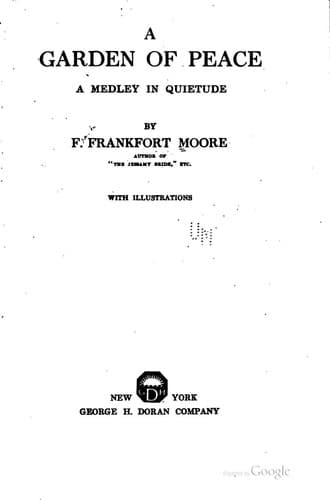
A Garden of Peace: A Medley in QuietudeMoore, Frank Frankfort
General
A Garden of Peace: A Medley in Quietude
Moore, Frank Frankfort
Gardens -- Fiction
“They were quite an effective medium for getting rid of his superfluous
steam,” said Dorothy to him. “I made no attempt to prevent his writing
them.”
“It would have been like sitting on the safety-valve, wouldn't it?” said
he. “I think that literature would not have suffered materially if
a good number of safety-valves had been sat upon by stouter wives of
metre-engineers than you will ever be, O guardian lady of the Garden of
Peace! The poets of the present hour have got much to recommend them to
the kindly notice of readers of taste, but they have all fallen short
of the true war note on their bugles. Perhaps when they begin to pipe of
peace they will show themselves better masters of the reed than of the
conch.”
“Whatever some of them may be----” I began, when he broke in.
“Say some of _us_, my friend: you can't dissociate yourself from your
pals in the dock: you will be sentenced _en bloc_, believe me.”
“Well, whatever _we_ may be we make a better show than the Marlborough
Muses or the Wellington or the Nelson Muses did. What would be thought
of _The Campaign_ if it were to appear to-morrow, I wonder. But it
did more in advancing the interests of Addison than the complete
_Spectator_.”
“Yes, although some feeble folk did consider that one hit of it was
verging on the blasphemous--that about riding on the whirlwind and
directing the storm,” remarked Friswell; he had a good memory for things
verging on the blasphemous.
“The best war poem is the one that puts into literary form the man in
the street yelling 'hurrah!'” said I. “If the shout is not spontaneous,
it sounds stilted and it is worthless.”
“I believe you,” said Friswell. “If your verse does not find an echo in
the heart of the rabble that run after a soldiers' band, it is but as
the sounding brass and tinkling cymbals that crash on the empty air. But
touching the poets of past campaigns----”
“I was thinking of Scott's _Waterloo_,” said I; “yes, and Byron's
stanzas in _Childe Harold_, and somebody's '_Twas in Trafalgar's Bay, We
saw the Frenchmen lay_--'the Frenchmen lav,' mind you--that's the most
popular of all the lays, thanks to Braham's music and Braham's tenor
that gave it a start. I think we have done better than any of those.”
“But have you done better than _Scot's what hae act Wallace hied? or of
Nelson and the North, Sing the glorious day's renown? or Ye Mariners
of England, That guard our native seas? or not a drum was heard or a
funeral note?_--I doubt it. And to come down to a later period, what
about the lilt of the Light Brigade at Balaclava, by one Tennyson? Will
any of the poems of 1914 show the same vitality as these?”
Public-domain text, read in full here on John Shaqi.
Reviews
Reviews
No reviews yet
Be the first to share your thoughts on this work.
Elsewhere in the archive
Join the Discussion
Join the discussion
Sign in to leave a comment or review.
Sign InorCreate an account