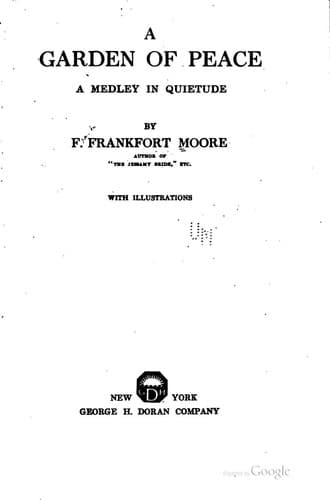
A Garden of Peace: A Medley in QuietudeMoore, Frank Frankfort
General
A Garden of Peace: A Medley in Quietude
Moore, Frank Frankfort
Gardens -- Fiction
The dark unfathomed caves of ocean bear;
Full many a flower is born to blush unseen,
And waste its sweetness on the desert air.”
That was a trite reflection; and as apposite as yours, Friswell; unless
you go on to assume that through the desert air there buzzed a bee to
carry off the soul of the blushing flower and cause it to fertilise a
whole garden, so that the desert was made to blossom like the rose.”
“Who was the bee that rescued the poem from the desert sheet that
enshrouded it?” asked Dorothy.
“I have never heard,” I said, nor had Friswell.
There was a long pause before he gave a laugh, saying--
“I wonder if you will kick me out of your garden when I tell you the
funny analogy to all this that the mention of the word desert forced
upon me.”
“Try us,” said 1. “We know you.”
“The thought that I had was that there are more busy bees at work than
one would suppose; and the mention of the desert recalled to my mind
what I read somewhere of the remarkable optimism of a flea which a man
found on his foot after crossing the desert of the Sahara. It had lived
on in the sand, goodness knows how long, on the chance of some animal
passing within the radius of a leap and so carrying it back to a
congenial and not too rasorial a civilisation. How many thousand million
chances to one there were that it should not be rescued; yet its chance
came at last.”
“Meaning?”
“Well, my flea is your bee, and where there are no bees there may be
plenty of fleas.”
“Yes; only my bee comes with healing in its wings, and your flea is the
bearer of disease,” said I; and I knew that I had got the better of him
there, though I was not so sure that he knew it.
Friswell is a queer mixture.
After another pause, he said,--
“By the way, the mention of Campbell and his group brought back to
me one of the most popular of the poems of the period--_Lord Ullin's
Daughter_.--You recollect it, of course.”
“A line or two.”
“Well, it begins, you know:--
“A chieftain to the Highlands bound,
Cries, 'Boatman, do not tarry,
And I'll give thee a silver pound,
To row us o'er the ferry.'
Now, for long I felt that it was too great a strain upon our credulity
to ask us to accept the statement that a Scotsman would offer a ferryman
a pound for a job of the market value of a bawbee; but all at once the
truth flashed upon me: the pound was a pound Scots, or one shilling and
eightpence of our money. You see?”
“Yes, I see,” said Dorothy; “but still it sounds extravagant. A Highland
Chief--one and eight-pence! The ferryman never would have got it.”
I fancied that we had exhausted some of the most vital questions bearing
upon the questionable poetry of the present and the unquestionable
poetry of the past; but I was mistaken; for after dinner I had a visit
from Mr. Gilbert.
But I must give Mr. Gilbert a little chapter to himself.
CHAPTER THE TWENTY-FIRST
Public-domain text, read in full here on John Shaqi.
Reviews
Reviews
No reviews yet
Be the first to share your thoughts on this work.
Elsewhere in the archive
Join the Discussion
Join the discussion
Sign in to leave a comment or review.
Sign InorCreate an account