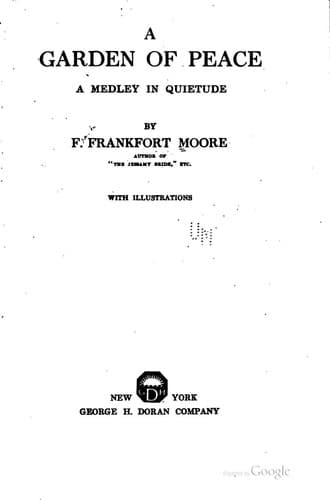
A Garden of Peace: A Medley in QuietudeMoore, Frank Frankfort
General
A Garden of Peace: A Medley in Quietude
Moore, Frank Frankfort
Gardens -- Fiction
“Well, you know, sir, they will never tell us plainly just what they are
driving at. For instance we were speaking of roses, just now--well, we
have roses and roses by the score in poems; but how seldom do we find
the roses specified! There's Matthew Arnold, for example; he wrote
“Strew on her roses, roses”; but he did not say whether he wanted her
to be strewn With hybrid teas, Wichuraianas, or poly-anthas. He does not
even suggest the colour. Now, could anything be more vague? It makes
one believe that he was quite indifferent on the point, which would,
of course, be doing him a great injustice: all these funeral orders are
specified, down to the last violets and Stephanotis. Then we have, “It
was the time of roses”--now, there's another ridiculously vague phrase.
Why could the poet not have said whether he had in his mind the ordinary
brier or an autumn-flowering William Allen Richardson or a Gloire de
Dijon? But that is not nearly so irritating as Tennyson is in places.
You remember his “Flower in the crannied wall.” There he leaves a
reader in doubt as to what the plant really was. If it was Saracta
Hapelioides, he should have called it a herb, or if it was simply the
ordinary Scolopendrium marginatum he should have called it a fern. If
it was one of the _Saxifrageo_ he left his readers quite a bewildering
choice. My own impression is that it belonged to the _Evaizoonia_
section--probably the _Aizoon sempervivoides_. though it really might
have been the _cartilaginea_. Why should we be left to puzzle over
the thing? But for that matter, both Shakespeare and Milton are most
flagrant offenders, though I acknowledge that the former now and again
specifies his roses: the musk and damask were his favourites. But why
should he not say whether it was _Thymus Scrpyllum or atropurpureus_ he
alluded to on that bank? He merely says, “Whereon the wild thyme blows.”
It is really that vagueness, that absence of simplicity--which has made
poetry so unpopular. Then think of the trouble it must be to a foreigner
when lie comes upon a line comparing a maiden to a lily, without
saying what particular _lilium_ is meant. An Indian squaw is like a
lily--_lilium Brownii_; a Japanese may appropriately be said to be like
the _lilium sulphureum_. Recovering from a severe attack of measles a
young woman suggests _lilium speciosum_; but that is just the moment
when she makes a poor appeal to a poet. To say that a maiden is like a
lily conveys nothing definite to the mind; but that sort of neutrality
is preferable to the creation of a false impression, so doing her a
great injustice by suggesting it may be that her complexion is a bright
orange picked out with spots of purple.”
Public-domain text, read in full here on John Shaqi.
Reviews
Reviews
No reviews yet
Be the first to share your thoughts on this work.
Elsewhere in the archive
Join the Discussion
Join the discussion
Sign in to leave a comment or review.
Sign InorCreate an account