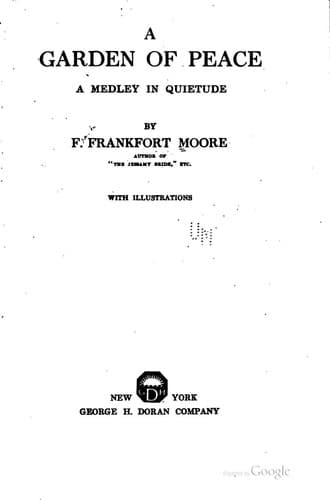
A Garden of Peace: A Medley in QuietudeMoore, Frank Frankfort
General
A Garden of Peace: A Medley in Quietude
Moore, Frank Frankfort
Gardens -- Fiction
Now the building had always been an offence to me. It was like an
incompetent servant, who, in addition to being incapable of earning
his wages, is possessed of an enormous appetite. With an old-fashioned
heating apparatus the amount of fuel it consumed year by year was
appalling; and withal it had more than once played us false, with the
result that several precious lives were lost in a winter when we looked
to the greenhouse to give us some colour for indoors. With such a list
of convictions against it, I was not disposed to be lenient, and the
suggestion of the discipline of a Reformatory was coldly received by me.
The fact was, that in my position as judge, I resembled too closely the
one in Gilbert's _Trial by Jury_ to allow of my being trusted implicitly
in cases in which personal attractions are to be put in the scales of
even-handed Justice; and with all its burden of guilt that greenhouse
bore the reputation of unsightliness. If it had had a single redeeming
feature, I might have been susceptible to its influence; but it had
none. It had been born commonplace, and old age had not improved it.
Leaning against the uttermost boundary wall of the garden, it had been
my achievement to hide it by the hedge of briar roses and the colonnade;
but it was sometimes only with great difficulty that we could head
off visitors from its doors. Heywood heaped on it his concentrated
opprobrium by calling it the Crystal Palace; but Dorothy, who had been a
student of _Jane Eyre_, had given it the name of “Rochester's Wife,” and
we had behaved toward it pretty much as Jane's lover had behaved in his
endeavour to set up a younger and more presentable object in the place
of his mature demented partner: we had two other glass-houses that we
could enter and see entered without misgiving; so that when we
stood beside the offending one with the estimate of the cost of its
reformation, I, at any rate, was not disposed to leniency.
“A case for the Reformatory,” said Dorothy, and in a moment the word
brought to my mind the advice of the young lord Hamlet, and I called
out,--
“Reform it altogether.”
“What do you mean?” she asked; for she sometimes gives me credit for
uttering words with a meaning hidden somewhere among the meshes of
verbiage.
“I have spoken the decision of the Court,” I replied. “'Reform it
altogether.'”
“At a cost--a waste--of sixty odd pounds?”
“I will not try to renew its youth like the eagles,” said I, in the tone
of voice of a prophet in the act of seeing a vision. “I shall make a new
thing of it, and a thing of beauty into the bargain.”
She laughed pretty much as in patriarchal days Sara, laughed at the
forecast of an equally unlikely occurrence.
After an interval she laughed again, but with no note of derision.
“I see it all now-all!” she cried. “You will be the Martin Luther of its
Reformation: you will cut the half of it away; but will the Church stand
when you have done with it?”
Public-domain text, read in full here on John Shaqi.
Reviews
Reviews
No reviews yet
Be the first to share your thoughts on this work.
Elsewhere in the archive
Join the Discussion
Join the discussion
Sign in to leave a comment or review.
Sign InorCreate an account