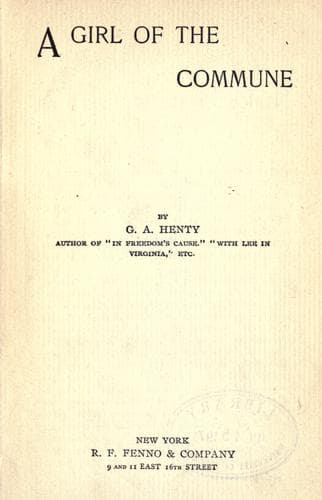
Paris (France) -- History -- Commune, 1871 -- Fiction
Mary Brander conscientiously tried to carry out the doctor's
instructions, walked briskly along the Boulevards, and then going up the
Champs Elysees, and turning to the left, went to the edge of the plateau
above the river, and there sat down on a bench and looked over the
country to the south. There were many groups of people gathered at this
point; most of them, doubtless, like herself, had friends in the army
gathered outside the walls, and were too anxious and restless to remain
indoors; but although her eyes were fixed on the country beyond the
forts, Mary Brander did not take in the scene. She was thinking, as she
had been for the last two days, and was full of regrets for the past.
She had not altogether admitted this to herself, but she knew now that
it was so, although she had fought hard and angrily with herself before
she owned it.
"He was right," she said to herself bitterly, "when he said that I had
not yet discovered that I had a heart as well as a head. We are
miserable creatures, we women. A man can go straight on his way through
life--he can love, he can marry, but it makes no change in his course. I
know I read somewhere that love is but an incident in a man's life,
while it is a woman's all, or something of that sort. I laughed at the
idea then as absurd--now that it is too late I see it is true. He loved
me, or, at least he liked me so much that he thought it was love. I
laughed at him, I told him he was not worthy of a woman's love. He went
away. Here was an end of it, as far as he was concerned. He lost his
property and took to work nobly, and when we met he was just the same as
he had been before, and treated me as if I had been a cousin, and has no
doubt laughed many a time at the thought of that morning in the garden
at Newquay, and indeed thought so little of it that he did not mind my
seeing all those sketches of that woman in his note-books.
"There were three or four of them, too, stuck up on the walls of his
room. Of course she goes there. He said she was a model. Of course he is
fond of her. I should not have thought it of him, but men are wicked and
women are fools," she added, after a pause, "and I do think that I am
one of the most foolish of them. I am like a child who throws away a toy
one minute and cries for it the next. It is horrid, and I am ashamed of
myself, downright ashamed. I hate myself to think that just because a
man is nice to me, and leaves me two pictures if he is killed, that I am
to make myself miserable about him, and to feel that I could give up all
my plans in life for his sake. I understand now how it is that women are
content to remain what they are. It is because nature made them so. We
are like weathercocks, and have no fixed point, but can be turned by a
passing breath.
Public-domain text, read in full here on John Shaqi.
Reviews
Reviews
No reviews yet
Be the first to share your thoughts on this work.
Elsewhere in the archive
Join the Discussion
Join the discussion
Sign in to leave a comment or review.
Sign InorCreate an account