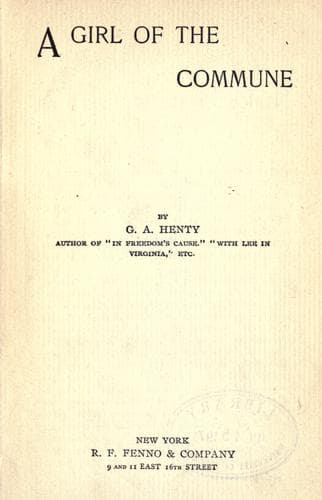
Paris (France) -- History -- Commune, 1871 -- Fiction
"Yes, if you feel equal to it. It is possible," he thought to himself,
as he went to the next marquee, "that the poor fellow only regards her
as a cousin, but I am greatly mistaken if she has not very much warmer
feelings towards him, though she did so stoutly declare that they were
but old friends."
Mary, putting on her bonnet and cloak, went out. As she did so, a man,
in the uniform of the Franc-tireurs, and a young woman approached.
"Pardon, mademoiselle," he said, lifting his cap as he came up to her,
"is it possible for friends to visit the wounded?"
Mary glanced at the speaker's companion and at once recognized her. It
was the face of which she had seen so many drawings in Cuthbert's
sketch-book.
"It is not possible to-day," she said, "except in extreme cases. There
have been many applicants, but they have all been refused."
"I fear this is an extreme case," Rene, for it was he, urged. "It is a
comrade of mine, and the surgeon told me after examining him that he was
hit very seriously. This lady is his fiancee."
"I know who you mean," Mary said, after a moment's silence, "but she
could not see him even if she were his wife. He is asleep now and
everything depends upon his sleep being unbroken."
"If I could only see him I would not wake him," the woman wailed, while
Rene asked--
"Can you tell us if there are any hopes for him?"
"The surgeon says there are some hopes," Mary said, coldly, "but that
everything depends upon his being kept perfectly quiet. However, I have
no power in the matter. I am off duty now, and you had better apply to
Mrs. Stanmore. She is in charge of the ward. It is the farthest of the
three marquees."
"What is that woman to him?" Minette exclaimed, passionately, as Mary
walked on. "She loves him or she hates him. I saw her look at me as you
spoke first, and her face changed. She knew me though I did not know
her."
"Oh, that is all fancy, Minette. How can she know Arnold? She is tired
and worn out. Parbleu, they must have had terrible work there since the
sortie began. It is getting dark, but it is easy to see how pale and
worn out she looked. For my part I would rather go through that fight in
the garden again than work for twenty-four hours in a hospital."
"She knows him," the girl said, positively.
"Well, let us go on. This woman may give you leave to go in."
But Mrs. Stanmore was also firm in her refusal.
"We cannot allow even the nearest relatives to enter," she said, "we are
all taken up by duty and cannot have strangers in the wards; but if the
patient is likely to die and wishes to see a friend or relative in the
city we send for him or her. If you will give me your name and address I
will see that you are sent for should the patient ask for you. The rule
I can assure you is absolute, and I have no power whatever to grant
permission to anyone except in the case I have named."
Minette went away raving, and it needed indeed all Rene's remonstrances
and entreaties to induce her to leave.
Public-domain text, read in full here on John Shaqi.
Reviews
Reviews
No reviews yet
Be the first to share your thoughts on this work.
Elsewhere in the archive
Join the Discussion
Join the discussion
Sign in to leave a comment or review.
Sign InorCreate an account