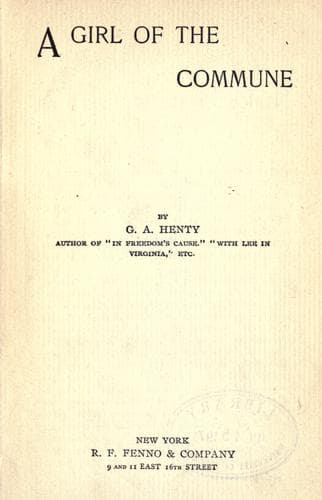
Paris (France) -- History -- Commune, 1871 -- Fiction
"It is all very well to say, honor your father and mother, but if you
can't honor them what are you to do? I have no doubt I am worrying
myself for nothing now, but I can't help it. It is dreadful to feel
like that towards one's father, but I felt quite a chill run through me
when Cuthbert said he should go and see that man Cumming and try to get
to the bottom of things. One thing is certain, I will never live at
Fairclose--never. If he leaves it between us, Julia and Clara may live
there if they like, and let me have so much a year and go my own way.
But I will never put foot in it after father and mother are gone. It is
all very miserable, and I do think I am getting to be a most hateful
girl. Here am I suspecting my own father of having done something wrong,
although of what I have not the least idea, and that without a shadow of
reason, then I am almost hating a woman because a man I refused loves
her. I have become discouraged and have thrown up all the plans I had
laid down for myself, because it does not seem as easy as I thought it
would be. No, that is not quite true. It is much more because Cuthbert
has laughed me out of them. Anyhow I should be a nice woman to teach
other women what they should do, when I am as weak as the weakest of
them. I don't think there ever was a more objectionable sort of girl in
the world than I have become."
By the time that she had arrived at this conclusion she had nearly
reached home. A sudden feeling that she could not in her present mood
submit to be petted and fussed over by Madame Michaud struck her, and
turning abruptly she walked with brisk steps to the Arc de Triomphe and
then down the Champs Elysees and along the Rue Rivoli, and then round
the Boulevards, returning home fagged out, but the better for her
exertion. One thing she determined during her walk, she would give up
her work at the ambulance.
"There are plenty of nurses," she said, "and one more or less will make
no difference. I am miserably weak, but at any rate I have sense enough
to know that it will be better for me not to be going there every day,
now that he is out of danger. He belongs to someone else, and I would
rather die than that he should ever dream what a fool I am; and now I
know it myself it will be harder and harder as he gets better to be
talking to him indifferently." Accordingly the next morning, when she
went down, she told Dr. Swinburne that she felt that she must, at any
rate for a time, give up nursing.
Public-domain text, read in full here on John Shaqi.
Reviews
Reviews
No reviews yet
Be the first to share your thoughts on this work.
Elsewhere in the archive
Join the Discussion
Join the discussion
Sign in to leave a comment or review.
Sign InorCreate an account