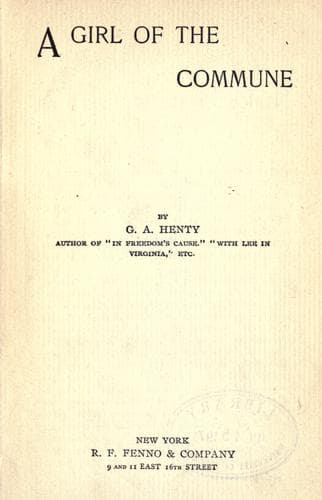
Paris (France) -- History -- Commune, 1871 -- Fiction
"It would be necessary to satisfy the official liquidator, however, who
might make some inquiries concerning it. It happened that some time
before the lawyer had had occasion to pay over the sum of L15,000, as he
would be able to prove by his bank-book. Therefore, L15,000 was the sum
fixed upon for the mortgage, and the date of that document was made to
coincide with that of the payment of that amount. It was easy enough to
place among the dead man's papers receipts for the half-yearly payment
of this interest. It was not necessary to show that his client had paid
these sums by check, as they would, of course, have been deducted from
the amount to be handed over by him as agent to his client.
"The scheme worked admirably. After the death of his client, the bank
was allowed to break, the estate fell into the hands of the official
receiver of the bank, the mortgage was presented, and the proofs
considered satisfactory. The lawyer bought the estate for some L20,000
below its value, and this with the mortgage brought the purchase money
down from L70,000 to half that sum. The story is interesting, and if
anyone should doubt it I am in a position to prove it up to the hilt. I
have the sworn statement of the bank manager as to the particulars of
the interview with him, the injunction that the transfer should be
passed unnoticed, the offer to support the bank, and the partial
fulfilment of that offer. I have the opinion of an expert that the
signature is not only a forgery but an exceedingly clumsy one. I have
the statement of one of the clerks that the signature of both the
transfer and the mortgage was witnessed by him and his fellow-clerk in
obedience to the orders of the solicitor, but they did not see the
signature affixed.
"Lastly, I have a singular piece of evidence that the mortgage was
signed not on the date it purported but shortly after the seizure of the
client. The clerk might have had some difficulty in swearing that this
mortgage was the document that he signed, as the signatures were written
on the last sheet of the parchment, and he saw nothing of the contents.
But it happened that there were only four lines of writing on that page,
and there are four on the mortgage in the hands of the official
liquidator, but this is not the crucial point. The clerk, in making his
signature, dropped a blot of ink on the parchment. Now it was clear that
this blot of ink might prove the means o identifying this document and
of proving the time at which it was signed; therefore it was necesssary
that it should be erased. This the lawyer proceeded to do and so
cleverly that an unpracticed eye would not detect it. The expert,
however, though not knowing where the blot had fallen, detected the
erasure at once, and noticed that in erasing it two of the letters of
the name had been involved, and these had been retouched so as to make
them the same darkness as the rest. The chain of evidence is therefore
complete."
Public-domain text, read in full here on John Shaqi.
Reviews
Reviews
No reviews yet
Be the first to share your thoughts on this work.
Elsewhere in the archive
Join the Discussion
Join the discussion
Sign in to leave a comment or review.
Sign InorCreate an account