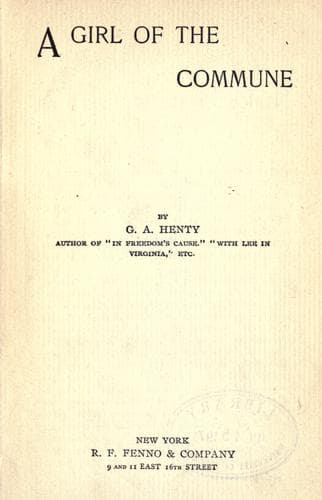
Paris (France) -- History -- Commune, 1871 -- Fiction
"Mr. Brander," he said at last, "I feel, and I think naturally, very
sore at the cruel wrong that has been inflicted upon me, but I cannot
forget that in my boyhood I was always received with kindness by your
wife, and for her sake, and that of your daughters, I am most anxious
your reputation should remain untarnished. I am willing to believe that
this crime was the result of a sudden impulse, and that in other
respects you have been an honest man. I cannot forget, too, that my
father had a great esteem for you. As to the two years' rents you have
received, I will not claim them. I have done well enough without them,
and in fact the necessity for working for my living has been of great
advantage to me, and that alone makes me less inclined than I otherwise
might be to press hardly upon you. I will, therefore, make this offer.
You shall sign a paper that I have drawn up confessing the share you
have taken in this business. That paper I pledge myself solemnly to keep
a profound secret, unless by any subsequent actions you force me to use
it in self-protection, and that you will sign a deed of gift to me of
Fairclose and its estates, subject to the mortgage of L20,000. You can
hand me over the deeds of the estate and I will have the deed of gift
drawn up. You will also give me your promise to leave this town and
settle elsewhere. On these conditions, I pledge you my word that the
transactions by which you obtained possession of the estates shall not
be divulged, and that the high reputation you bear shall be altogether
unsullied."
"God bless you, Mr. Hartington," the lawyer said, in a broken voice,
"for your generosity in sparing my wife and children from the shame and
disgrace that would have fallen upon them had you insisted on your
rights. It is more than I deserve. I have never had a day's happiness
since I came here; it seemed to me that all danger of detection had
passed, and yet it was ever before me. I was ever dreading that in some
way I had not provided against, it would come out."
"May I ask what income you will draw from your business?"
"The business is worth between four and five thousand a year, and by my
deed of partnership I was to receive two-thirds of that as long as I
myself chose to take a share in the management, and one-third when I
like to retire altogether. A thousand a year is to be paid to my widow
after my death, and two hundred apiece to my daughters at her death."
"So you will have some fifteen hundred a year, Mr. Brander, and with
that and the six thousand you have invested you will not do badly. I
shall return to town this evening again and will bring down the deed as
soon as it is prepared."
Public-domain text, read in full here on John Shaqi.
Reviews
Reviews
No reviews yet
Be the first to share your thoughts on this work.
Elsewhere in the archive
Join the Discussion
Join the discussion
Sign in to leave a comment or review.
Sign InorCreate an account