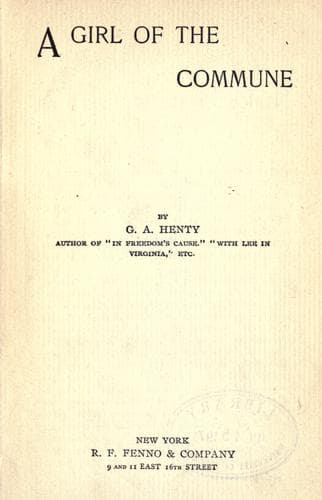
Paris (France) -- History -- Commune, 1871 -- Fiction
On the 25th of April, at 8 o'clock in the morning, the long silence of
the besiegers' batteries ended. Cuthbert was taking his coffee when he
heard a sound like the rumble of a heavy wagon. He ran to his window.
There was quiet in the street below, for everyone had stopped abruptly
to listen to the roar, and from every window heads appeared. Completing
his dressing hastily, he went out and took the first fiacre he met and
drove to Passy. The rumble had deepened into a heavy roar; the air
quivered with the vibrations, and the shriek of the shells mingled with
the deep booming of the guns. When he entered Madame Michaud's, she, her
husband and Mary were standing at the open window.
"We have just come down from the top of the house," Mary said, "it is a
grand sight from there; will you come up, Cuthbert?"
"Certainly, Mary; you see I was right, and there do not seem to be any
shell coming this way."
"No. But we were all desperately alarmed, were we not madame, when they
began."
"It was enough to alarm one," Madame Michaud said indignantly, "half the
windows were broken, and that was enough to startle one even without the
firing."
"It was perfectly natural, madame," Cuthbert agreed; "the first shock is
always trying, and even soldiers with seasoned nerves might be excused
for starting, when such a din as this commenced."
Cuthbert and Mary went up at once to the roof, where the old gentleman
from below had already set up his telescope. He did not need that,
however, to observe what was going on. Along almost the whole crest of
the eminences round the south and west, heavy guns were playing upon the
defences. From the heights of Chatillon, the puffs of white smoke came
thick and fast, the battery at the Chateau of Meudon was hard at work,
as were those of Brimborien and Breteuil. Mount Valerien was joining in
the fray, while batteries on the plateau of Villejuif were firing at the
forts of Montrouge and Bicetre. Without exception, the greater part of
the fire was concentrated upon the forts of Issy and Vanves, while
attention was also being paid to the batteries at Point de Jour and
Porte Maillot.
The Communists replied to the fire steadily, although Issy, which came
in for by far the largest share of the attentions of the assailants,
fired only a gun now and then, showing that it was still tenanted by the
defenders. It was difficult indeed to see how often it replied, for the
shell burst so frequently on it that it was difficult to distinguish
between their flashes and those of its guns. Through the telescope could
be seen how terrible was the effect of the fire; already the fort had
lost the regularity of its shape, and the earth, with which it had been
thickly covered, was pitted with holes. Presently there was an outburst
of firing comparatively close at hand.
"That is the battery on the Trocadero," one of the party exclaimed. "I
think that they must be firing at Valerien, I saw several spurts of
smoke close to it."
Public-domain text, read in full here on John Shaqi.
Reviews
Reviews
No reviews yet
Be the first to share your thoughts on this work.
Elsewhere in the archive
Join the Discussion
Join the discussion
Sign in to leave a comment or review.
Sign InorCreate an account