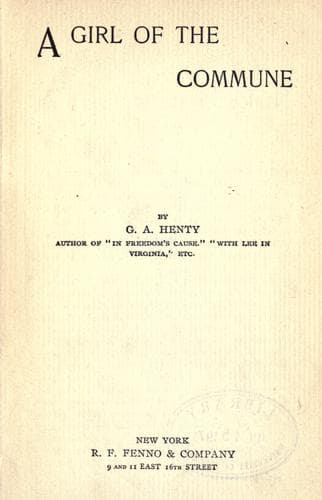
Paris (France) -- History -- Commune, 1871 -- Fiction
At the Railway Station at Clamart there was also heavy fighting; the
National Guard attacked suddenly and in such overwhelming numbers that
after a short but desperate resistance, the garrison of the station were
forced to retire. Reinforcements were soon brought up, the troops again
advanced and the insurgents were driven out. Their loss during the night
was put down as a thousand. On the 8th Montretout, which was armed with
72 heavy guns, opened fire, the rest of the batteries joined in, and for
a couple of hours the din was terrific. The next day Issy was captured
by the troops. They attacked the village at daybreak, and advancing
slowly, capturing house by house, they occupied the church and
marketplace at noon. Just as they had done so, a battalion of Insurgents
were seen advancing, to reinforce the garrison of the Fort. They were
allowed to advance to within fifty yards when a heavy volley was poured
into them. They halted for a moment, but their colonel rallied them. He
was, however, killed by another volley, when the men at once broke,
threw away their arms, and ran back to the city gates. The rest of the
village was carried with a rush, and when the troops reached the gate of
the Fort, it was found open. It was at once occupied, the whole of the
defenders having fled, as they saw that the steady advance of the troops
would, if they remained, cut them off from escape. The fall of the Fort
was so unexpected that the batteries on the heights continued to fire
upon it for some time after the troops had gained possession.
The capture of Issy created an immense effect in Paris. General Rossel
resigned the command of the insurgent army. He had been a colonel of the
engineers, and was an officer of merit, but his political opinions had
proved too much for his loyalty to his country and profession; doubtless
he had deemed that if, as at first seemed probable, the insurrection
would be successful and the revolution triumph, he would become its
Napoleon. He now saw the ruin of his hopes; he had forfeited his
position and his life, and in the proclamation he issued announcing his
resignation he poured out all the bitterness of his disappointment, and
told the Commune his opinion of them, namely, that they were utterly
incapable, without an idea of the principles either of liberty or of
order, and filled only with jealousy and hatred of each other. So
scathing was the indictment, that he was at once arrested, but managed
to make his escape.
Public-domain text, read in full here on John Shaqi.
Reviews
Reviews
No reviews yet
Be the first to share your thoughts on this work.
Elsewhere in the archive
Join the Discussion
Join the discussion
Sign in to leave a comment or review.
Sign InorCreate an account