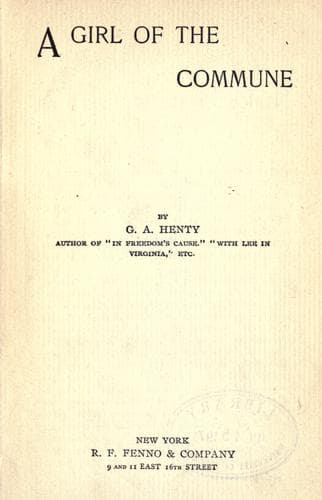
Paris (France) -- History -- Commune, 1871 -- Fiction
"You cannot pass here," the officer in charge said, as Cuthbert produced
his permit, "the island is still in the hands of the Communists, and the
fire from their barricade across the bridge sweeps the street twenty
yards farther on, and it would be certain death to show yourself there;
besides, they are still in force beyond the Hotel de Ville. You can, of
course, work round by the left, but I should strongly advise you to go
no farther. There is desperate fighting going on in the Place de la
Bastille. The insurgent batteries are shelling the Boulevards hotly,
and, worst of all, you are liable to be shot from the upper windows and
cellars. There are scores of those scoundrels still in the houses; there
has been no time to unearth them yet, and a good many men have been
killed by their fire."
"Thank you, sir. I will take your advice," Cuthbert said.
He found, indeed, that there was no seeing anything that was going on in
the way of fighting without running great risks, and he accordingly made
his way back to the Trocadero. Here he could see that a number of fires
had broken out at various points since morning, even in the part of the
town occupied by the troops; and though some of these might be caused by
the Communists' shell it was more probable that they were the work of
the incendiary. He had, indeed, heard from some of the citizens to whom
he had spoken while at work at the pumps, that orders had been issued
that all gratings and windows giving light to cellars, should be closed
by wet sacks being piled against them, and should then be covered
thickly with earth, as several women had been caught in the act of
pouring petroleum into the cellars and then dropping lighted matches
down upon it.
These wretches had been shot instantly, but the fresh fires continually
springing up showed that the work was still going on.
It was strangely silent in the streets. With the exception of the
sentries at every corner there were few persons indeed abroad. Many were
looking from the windows, but few, indeed, ventured out. They knew not
what orders had been given to the sentries and feared arrest were they
to stir beyond their doors. Moreover, the occasional crash of a shell
from the insurgent batteries, the whistling of bullets, and the frequent
discharge of musket shots still kept up by groups of desperate
Communists who had taken refuge in the houses, was sufficient alone to
deter them from making any attempt to learn what was going on. But in
the absence of footfalls in the street and of the sound of vehicles, the
distant noises were strangely audible. The rustle of the flames at the
Hotel de Ville and the great fires across the river, the crash of the
falling roofs and walls, the incessant rattle of distant musketry, and
the boom of cannon, formed a weird contrast to the silence that
prevailed in the quarter. Cuthbert felt that he breathed more freely
when he issued out again into the Champs Elysees.
Public-domain text, read in full here on John Shaqi.
Reviews
Reviews
No reviews yet
Be the first to share your thoughts on this work.
Elsewhere in the archive
Join the Discussion
Join the discussion
Sign in to leave a comment or review.
Sign InorCreate an account