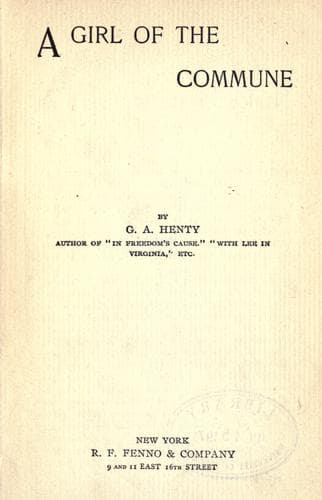
Paris (France) -- History -- Commune, 1871 -- Fiction
"Really," he broke in with a laugh, "I must protest against being
considered so weak and unstable. You had a perfect right in thinking me
lazy, but I don't think you have any right in considering me a reed to
be shaken by every passing wind. I can assure you that I am very fixed
in my resolves. I was content to be lazy before simply because there was
no particular reason for my being otherwise, and I admit that
constitutionally I may incline that way; but when a cataclysm occurred,
and, as I may say, the foundations were shaken, it became necessary for
me to work, and I took a resolution to do so, and have stuck to it.
Possibly I should have done so in any case. You see when a man is told
by a young lady he is a useless idler, who does but cumber the earth, it
wakes him up a little."
"I am sure I didn't say that," Mary said, indignantly, but with a hot
flush on her cheeks.
"Not in those precise words, but you spoke to that effect, and my
conscience told me you were not far wrong in your opinion. I had begun
to meditate whether I ought not to turn over a new leaf when I came in
suddenly for Fairclose; that of course seemed to knock it all on the
head. Then came what we may call the smash. This was so manifestly an
interposition of Providence in the direction of my bestirring myself
that I took the heroic resolution to work."
Mary felt that it was desirable to avoid continuing the subject. She had
long since come to regard that interview in the garden as a sort of
temporary aberration on his part, and that although, perhaps, sincere at
the moment, he had very speedily come to laugh at his own folly, and had
recognized that the idea was altogether ridiculous. Upon her it had made
so little impression that it had scarcely occurred to her when they met,
that any passage of the sort had taken place, and had welcomed him as
the lad she had known as a child, rather than as the man who had, under
a passing impulse, asked her to marry him.
"I think," she said suddenly, "I will fetch Madame Michaud in. It will
be nice for you to come here in the evening sometimes, and it would be
better for her to ask you to do so than for me. These French people have
such funny ideas."
"It would certainly be more pleasant," he agreed, "and evening will be
the time that I have most leisure--that is to say, when we do not happen
to be on duty, as to which I am very vague at present. They say the
sailors will garrison the forts and the army take the outpost duty; but
I fancy, when the Germans really surround us, it will be necessary to
keep so strong a force outside the walls, that they will have to call
out some of us in addition. The arrangement at present is, we are to
drill in the morning and we shall paint in the afternoon; so the evening
will be the only time when we shall be free."
"What do you do in the evening generally? You must find it very lonely."
Public-domain text, read in full here on John Shaqi.
Reviews
Reviews
No reviews yet
Be the first to share your thoughts on this work.
Elsewhere in the archive
Join the Discussion
Join the discussion
Sign in to leave a comment or review.
Sign InorCreate an account