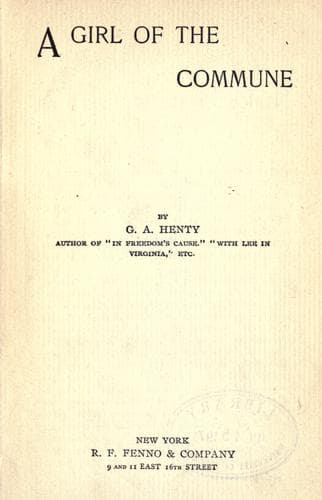
Paris (France) -- History -- Commune, 1871 -- Fiction
"Who drove you! Drink and your evil temper drove you to it. You wanted
to marry me--me who never gave you a word of encouragement; who knew you
_au fond_, who knew that you were at the best an idle, worthless scamp,
and would never have married you had there been no other living man in
the universe. But enough. I have said what I came to say, and you had
best take warning. Come, father, you have stood this fellow's friend,
and you have been wrong, but you know him now."
Minette passed out through the door Arnold held open for her; her father
and Arnold followed, and the four other men, without a word to Jean
Diantre, went down the stairs after them, leaving him to himself.
CHAPTER IX.
"It is hardly worth while, Minette," Arnold said, when they reached the
street, "the man has had his lesson."
"I could not help it, dear," she said, in a voice so changed from that
in which she had spoken to Jean Diantre, that no one would have
recognized it as the same; "he had tried to kill you, to take you from
me. He thought it was you who had struck him and hated you worse than
ever. It is not because he has failed once that he might fail another
time. I should never have had a moment's peace when you were away from
me, but I think now you will be safe; he will remove his quarters and go
to Villette or to the South side; he will not dare to show his face in
Montmartre again. You are sure you always carry your pistol, Arnold?"
"Yes, I promised you I would and I have done so. I have a small revolver
in each pocket."
"Then in future, when you are out at night promise me always to walk
with one hand in your pocket, holding the butt of your pistol, so that
you can draw and fire instantly. He knows you have pistols and will not
dare to attack you singly, and even should he find two or three villains
as bad as himself you would be a match for them."
"I will take care of myself, Minette, but I do not think it likely that
he will renew the attempt. I could see that the man was a coward. He was
as pale as a sheet, partly with rage that he had been discovered and
exposed, but partly, I am sure, from fear too. I know you meant well,
dear, but I would rather that you had not done it. I love you best when
you are gentle and womanly. You almost frighten me when you blaze out
like that."
"I am sorry," she said, penitently; "but I felt for the time mad that
your life should have been attempted. I scarcely knew what I was saying.
Do you think that anyone could be gentle and mild when she had just
heard that her lover, her all, had been almost taken from her by a
cowardly blow. Still I know I am wrong. Do not be angry with me,
Arnold."
"I am not angry, dear," he said, and truly, for no man can feel really
angry with a woman for over-zeal in his own cause. "Do not let us say
any more about it; the fellow is not worth a thought. We shall probably
never hear of him again."
Public-domain text, read in full here on John Shaqi.
Reviews
Reviews
No reviews yet
Be the first to share your thoughts on this work.
Elsewhere in the archive
Join the Discussion
Join the discussion
Sign in to leave a comment or review.
Sign InorCreate an account