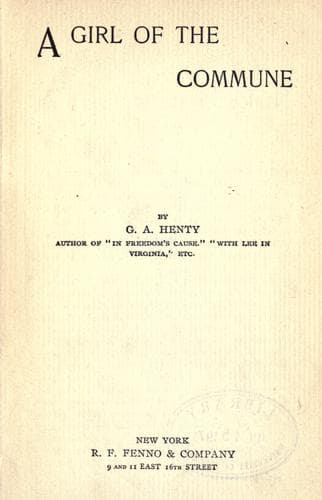
Paris (France) -- History -- Commune, 1871 -- Fiction
"More fools they who gave them to them, but what can one expect from
such a Government. There is not among them a single practical man except
Gambetta, and he is away at Tours. It is a Government of lawyers and
spouters; of words they give us plenty, of government nothing. I would
rather, infinitely rather, that the women at the Halles should chose a
dozen of the most capable women among them and establish them as the
Government. I will guarantee you would see a change for the better
before twenty-four hours were over. I doubt if you could see a change
for the worse. Jules Fauvre with his ridiculous phrase, not one foot of
our territory, not one stone of our fortresses, is no better than a
mountebank, and the others are as bad. Would that either Ducrot or Vinoy
had the firmness and half the talent of a Napoleon. They would march the
troops in, sweep away this gathering of imbeciles, establish martial
law, disarm Belleville and Montmartre, shoot Floureus, Pyat, Blanqui,
and a hundred of the most noxious of these vermin; forbid all
assemblages, turn the National Guards into soldiers, and after rendering
Paris impotent for mischief turn their attention to the Germans. The one
thing that can save Paris to my mind is a military dictator, but I see
no sign of such a man being forthcoming."
"Bravo! bravo!" several of the students shouted, "what a pity it is that
you are an Englishman, Cuthbert. You would be just the man for us
otherwise."
"At any rate, I should do something and not let everything drift,"
Cuthbert retorted, joining in the laugh at his own unaccustomed
vehemence; "but there, we have broken our agreement, now let us revert
to art;" but the effort was vain, the talk soon drifted back again to
the siege, and many were the conjectures as to what Trochu's famous plan
could be and which point offered the most hopeful chance for the army to
pierce the German cordon.
Mary Brander had a fortnight before enrolling herself among the nurses
at the American ambulance, which was doing admirable work, and was
admitted by the French themselves to be a model which could be followed
with great advantage in their own hospitals. Here everything was neat,
clean, and well arranged. The wounded were lodged in tents which were
well ventilated and yet warm. The surgeons and some of the nurses were
also under canvas, while others, among whom was Mary Brander, went back
to their homes when their turn of duty was over. They had, like the
ladies who worked in the French hospitals, adopted a sort of uniform and
wore the white badge with the red cross on their arms. With this they
could go unquestioned, and free from impertinent remarks through the
thickest crowds, everyone making way for them with respectful civility.
Public-domain text, read in full here on John Shaqi.
Reviews
Reviews
No reviews yet
Be the first to share your thoughts on this work.
Elsewhere in the archive
Join the Discussion
Join the discussion
Sign in to leave a comment or review.
Sign InorCreate an account