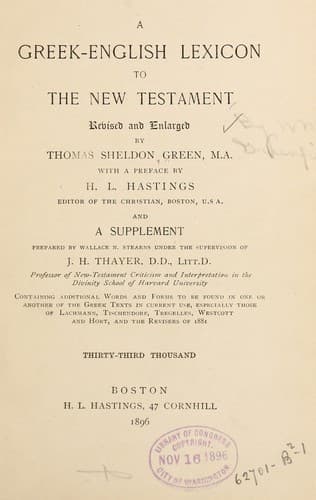
A Greek-English Lexicon to the New TestamentGreenfield, William
Religion
A Greek-English Lexicon to the New Testament
Greenfield, William
Bible. New Testament -- Dictionaries -- English; Greek language, Biblical -- Dictionaries -- English
to pray, offer prayer, Ac. 26.29. 2 Co. 13.7, 9. Ja. 5.16;
to wish, desire, Ac. 27.29. Ro. 9.3. 3 Jno 2.
Εὔχρηστος, ου, ὁ, ἡ, (εὖ & χρηστός)
highly useful, very profitable, 2 Ti. 2.21; 4.11. Phile. 11.
Εὐψυχέω, ῶ, (εὔψῡχος, of good courage, εὖ & ψυχή)
f. ήσω,
to be animated, encouraged, in good spirits, Phi. 2.19.
Εὐωδία, ας, ἡ, (εὐώδης, εὖ & ὄδωδα, ὄζω)
a sweet smell, grateful odour, fragrance, 2 Co. 2.15. Ep. 5.2.
Phi. 4.18.
Εὐώνῠμος, ου, ὁ, ἡ, (εὖ & ὄνομα)
of good name or omen; used also as an euphemism by the Greeks
instead of ἀριστερός, which was a word of bad import, as all
omens on the left denoted misfortune; the left, Mat. 20.21, 23;
25.33, 41, et al.
Ἔφᾰγον,
a. 2. of ἐσθίω.
Ἐφάλλομαι, (ἐπί & ἅλλομαι)
f. αλοῦμαι,
to leap or spring upon, assault, Ac. 19.16.
Ἐφάπαξ, (ἐπί & ἅπαξ)
adv. once for all, Ro. 6.10; at once, 1 Co. 15.6.
Ἐφεσῖνος, η, ον,
Re. 2.1, and
Ἐφέσιος, ία, ιον,
Ephesian, of Ἔφεσος, ου, ἡ, Ephesus, a city of Asia Minor,
Ac. 19.28, 34, 35; 21.29.
Ἐφευρετής, οῦ, ὁ, (ἐφευρίσκα, to come upon, find, discover,
fr. ἐπί & εὑρίσκω)
an inventor, deviser, Ro. 1.30.
Ἐφημερία, ας, ἡ,
pr. daily course; the daily service of the temple; a course
of priests to which the daily service for a week was allotted
in rotation, Lu. 1.5, 8: (L.G.) from
Ἐφήμερος, ου, ὁ, ἡ, (ἐπί & ἡμέρα)
lasting for a day; daily; sufficient for a day, necessary for
every day, Ja. 2.15.
Ἐφικνέομαι, οῦμαι, (ἐπί & ἱκνέομαι, to come)
f. ίξομαι, a.2 ἐφικόμην,
to come or reach to, to reach a certain point or end;
to reach, arrive at, 2 Co. 10.13, 14.
Ἐφίστημι, (ἐπί & ἵστημι)
f. ἐπιστήσω,
trans. to place upon, over, close by; intrans.
p. ἐφέστηκα, part. ἐφεστώς, a.2. ἐπέστην, mid. ἐφίσταμαι,
to stand by or near, Lu. 2.38; 4.39; to come suddenly upon,
Lu. 2. 9, 24; to come upon, assault, Ac. 6.12; 17.5; to come
near, approach, Lu. 10.40; to impend, be instant, be at hand,
1 Thes. 5.3; to be present, Ac. 28.2; to be pressing, urgent,
earnest, 2 Ti. 4.2.
Ἐφφαθα, (Aramaean, אתפתח)
be thou opened, Mar. 7.34.
Ἔχθρα, ας, ἡ,
enmity, discord, feud, Lu. 23.12. Gal. 5.20; alienation,
Ep. 2.15, 16; a principle or state of enmity, Ro. 8.7.
Ἐχθρός, ά, όν,
hated, under disfavour, Ro. 11.28; inimical, hostile,
Mat. 13.28. Col. 1.21; as a subs. an enemy, adversary,
Mat. 5.43, 44; 10.36. Lu. 6.27, 35, et al.
Ἔχιδνα, ης, ἡ, (ἔχις)
a viper, poisonous serpent, Ac. 28.3; used also fig. of
persons, Mat. 3.7.
Ἔχω
f. ἔξω, imperf. εἶχον, a.2. ἔσχον, p. ἔσχηκα,
to hold, Re. 1.16, et al.;
to seize, possess a person, Mar. 16.8;
to have, possess, Mat. 7.29, et al. freq.;
to have, have ready, be furnished with, Mat. 5.23. Jno. 5.36; 6.68, et al.;
to have as a matter of crimination, Mat. 5.23. Mar. 11.25, et al.;
to have at command, Mat. 27.65;
to have the power, be able, Mat. 18.25. Lu. 14.14. Ac. 4.14, et al.;
to have in marriage, Mat. 14.4. et al.;
Public-domain text, read in full here on John Shaqi.
Reviews
Reviews
No reviews yet
Be the first to share your thoughts on this work.
Elsewhere in the archive
Join the Discussion
Join the discussion
Sign in to leave a comment or review.
Sign InorCreate an account