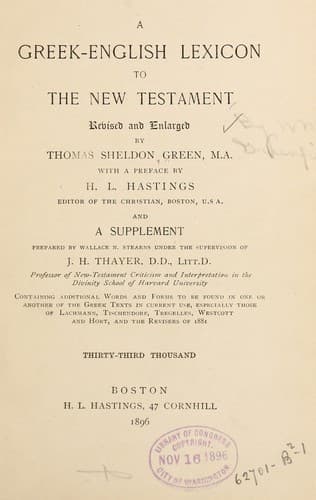
A Greek-English Lexicon to the New TestamentGreenfield, William
Religion
A Greek-English Lexicon to the New Testament
Greenfield, William
Bible. New Testament -- Dictionaries -- English; Greek language, Biblical -- Dictionaries -- English
7.6; becomingly, honourably,
Ja. 2.3; well, effectually, Mar. 7.9, 37, et al.; καλῶς εἰπεῖν,
to speak well, praise, applaud, Lu. 6.26; καλῶς ἔχειν,
to be convalescent, Mar. 16.18; καλῶς ποιεῖν, to do good,
confer benefits, Mat. 5.44; 12.12; to do well, act virtuously,
Phi. 4.14, et al.
Κἀμέ, (καὶ ἐμέ)
see κἀγώ.
Κάμνλος, ου, ὁ, ἡ, (Heb. גמל)
a camel, Mat. 3.4; 23.34, et al.
Κάμῑνος, ου, ἡ,
a furnace, oven, kiln, Mat. 13.42, 50. Re. 1.15; 9.2.
Καμμύω, (contr. for καταμύω, fr. κατά & μύω)
f. ύσω, a.1. ἐκάμμῠσα,
to shut, close the eyes, Mat. 13.15. Ac. 28.27.
Κάμνω,
f. καμοῦμαι, p. κέκμηκα, a.2. ἔκᾰμον,
pr. to tire with exertion, labour to weariness; to be wearied,
tried out, exhausted, He. 12.3. Re. 2.3; to labour under disease,
be sick, Ja. 5.15.
Κἀμοί, (καὶ ἐμοί)
see κἀγώ.
Κάμπτω,
f. ψω, a.1. ἔκαμψα,
trans. to bend, inflect, the knee, Ro. 11.4. Ep. 3.14;
intrans. to bend, bow, Ro. 14.11. Phi. 2.10.
Κἄν, (by crasis καὶ ἐάν)
and if, Mar. 16.18; also if, Mat. 21.21; even if, if even,
although, Jno. 10.38; if so much as, He. 12.20; also in N.T.,
simply equivalent to καί as a particle of emphasis, by a
pleonasm of ἄν, at least, at all events, Mar. 6.56. Ac. 5.15.
2 Co. 11.16.
Κανανίτης, ου, ὁ, (Aram. קנאן, fr. Heb. קנא, to be zealous)
Canaanite, i.q. ζηλωτής, zealot, Mat. 10.4. Mar. 3.18; coll.
Lu. 6.15, & Ac. 1.13.
Κανών, ονος, ὁ, (κάννα v. κάνη, a cane)
a measure, rule; in N.T., prescribed range of action or
duty, 2 Co. 10.13, 15, 16; met. rule of conduct or doctrine,
Ga. 6.16. Phil. 3.16.
Καπηλεύω,
f. εύσω,
(pr. to be κάπηλος, a retailer, huckster; and, as these
persons had the reputation of increasing their profits by
adulteration, hence,) in N.T., to corrupt, adulterate,
2 Co. 2.17.
Καπνός, οῦ, ὁ,
smoke, Ac. 2.19. Re. 8.4, et al.
Καρδία, ας, ἡ, (κέαρ, idem)
the heart; the heart, regarded as the seat of feelings,
impulse, affection, desire, Mat. 6.21; 22.37. Phil. 1.7, et al.;
the heart, as the seat of intellect, Mat. 13.15. Ro. 1.21, et al.;
the heart, as the inner and mental frame, Mat. 5.8. Lu. 16.15.
1 Pe. 3.4, et al.; the conscience, 1 Jno. 3.20, 21; the heart,
the inner part, middle, centre, Mat. 12.40, et al.
Καρδιογνώστης, ου, ὁ, (καρδία & γινώσκω)
heart-knower, searcher of hearts, Ac. 1.24; 15.8. N.T.
Καρπός, οῦ, ὁ,
fruit, Mat. 3.10; 21.19, 34; fr. the Heb. καρπὸς κοιλίας,
fruit of the womb, offspring, Lu. 1.42; καρπὸς ὀσφύος, fruit
of the loins, offspring, posterity, Ac. 2.30; καρπὸς χειλέων,
fruit of the lips, praise, He. 13.15; met. conduct, actions,
Mat. 3.8; 7.16. Ro. 6.22; benefit, profit, emolument,
Ro. 1.13; 6.21; reward, Phi. 4.17, et al.
Καρποφορέω, ῶ, (καρπός & φορέω, fr. φέρω
f. ήσω, a.1. ἐκαρποφόρησα,
to bear fruit, yield, Mar. 4.28; met. to bring forth or
exhibit actions or conduct, Mat. 13.23. Ro. 7.5; mid.
to expand by fruitfulness, to develop itself by success,
Col. 1.6.
Καρποφόρος, ου, ὁ, ἡ, (fr. same)
Public-domain text, read in full here on John Shaqi.
Reviews
Reviews
No reviews yet
Be the first to share your thoughts on this work.
Elsewhere in the archive
Join the Discussion
Join the discussion
Sign in to leave a comment or review.
Sign InorCreate an account