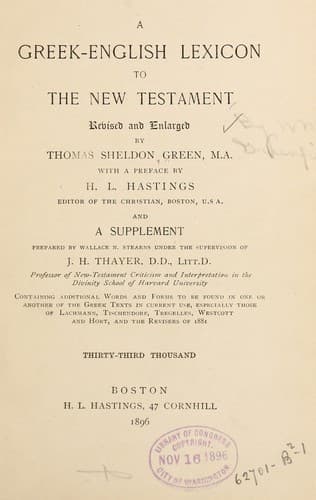
A Greek-English Lexicon to the New TestamentGreenfield, William
Religion
A Greek-English Lexicon to the New Testament
Greenfield, William
Bible. New Testament -- Dictionaries -- English; Greek language, Biblical -- Dictionaries -- English
it serves to express in general a settled futurity,
Mat. 11.14. Lu. 9.31. Jno. 11.51, et al.; to intend,
Lu. 10.1, et al.; particip. μέλλων, ουσα, ον, future
as distinguished from past and present, Mat. 12.32.
Lu. 13.9, et al.; to be always, as it were, about to do,
to delay, linger, Ac. 22.16.
Μέλος, εος, τό
a member, limb, any part of the body, Mat. 5.29, 30.
Ro. 12.4. 1 Co. 6.15; 12.12, et al.
Μεμβράνα, ης, ἡ, (Lat. membrana)
parchment, vellum, 2 Ti. 4.13.
Μέμφομαι,
f. ψομαι, a.1. ἐμεμψάμην,
to find fault with, blame, censure; to intimate
dissatisfaction with, He. 8.8; absol. to find fault,
Ro. 9.19.
Μεμψίμοιρος, ου, ὁ, ἡ, (μέμψις, a finding fault,
fr. μέμφομαι, & μοῖρα, a portion, lot)
finding fault or being discontented with one's lot,
querulous; a discontented, querulous person, a
repiner, Jude 16.
Μέν,
a particle serving to intimate that the term or
clause with which it is used, stands distinguished
from another, usually in the sequal, and then mostly
with δέ correspondent, Mat. 3.11; 9.37. Ac. 1.1;
ὁ μὲν,—ὁ δὲ, this—that, the one—the other, Phi. 1.16, 17;
one—another, οἱ μὲν—οἱ δὲ, some—others, Mat. 22.5, 6;
ὅς μὲν—ὅς δὲ, one—another, pl. some—others, Mat. 13.8; 21.35;
ἄλλος μὲν—ἄλλος δὲ, one—another, 1 Co. 15.39;
ὧδε μὲν—ἐκεῖ δὲ, here—there, He. 7.8;
τοῦτο μὲν—τοῦτο δὲ, partly—partly, He. 10.33, et al. freq.
Μενοῦν, v. μὲν οὖν,
see οὖν.
Μενοῦνγε, (μέν, οὖν, γε)
a combination of particles serving to take up what has
just preceded with either addition or abatedment, like
the Latin imo; yea indeed, yea truly, yea rather, Lu. 11.28.
Ro. 9.20; 10.18. Phi. 3.8. N.T.
Μέντοι, (μέν & τοι)
conj. truly, certainly, sure, Ju. 8; nevertheless, however,
Jno. 4.27, et al.
Μένω,
f. μενῶ, p. μεμένηκα, a.1. ἔμεινα,
to stay, Mat. 26.38. Ac. 27.31; to continue, 1 Co. 7. 11.
2 Ti. 2.13; to dwell, lodge, sojourn, Jno. 1.39. Ac. 9.43,
et al.; to remain, Jno. 9.41; to rest, settle,
Jno. 1.32, 33; 3.36; to last, endure, Mat. 11.23.
Jno. 6.27. 1 Co. 3.14; to survive, 1 Co. 15.6; to be
existent, 1 Co. 13.13; to continue unchanged, Ro. 9.11;
to be permanent, Jno. 15.16. 2 Co. 3.11. He. 10.34; 13.14.
1 Pe. 1.23; to perservere, be constant, be stedfast,
1 Ti. 2.15. 2 Ti. 3.14; to abide, to be in close and
settled union, Jno. 6.56; 14.10; 15.4, et al.; to
indwell, Jno. 5.38. 1 Jno. 2.14; trans. to wait for,
Ac. 20.5, 23.
Μερίζω, (μέρις)
f. ίσω,
to divide; to divide out, distribute, Mar. 6.41;
to assign, bestow, Ro. 12.3. 1 Co. 7.17. 2 Co. 10.13.
He. 7.2; mid. to share, Lu. 12.13; pass. to be subdivided,
to admit distinctions, 1 Co. 1.13; to be servered by discord,
be at variance, Mat. 12.35, et al.; to differ, 1 Co. 7.34.
Μέριμνα, ης, ἡ, (μερίζειν τὸν νοῦν, dividing the mind)
care, Mat. 13.22. Lu. 8.14, et al.; anxious interest,
2 Co. 11.28:
whence
Μεριμνάω, ῶ,
f. ήσω, a.1. ἐμερίμνησα,
to be anxious, or solicitous, Phi. 4.6; to expend
careful thought, Mat.
Public-domain text, read in full here on John Shaqi.
Reviews
Reviews
No reviews yet
Be the first to share your thoughts on this work.
Elsewhere in the archive
Join the Discussion
Join the discussion
Sign in to leave a comment or review.
Sign InorCreate an account