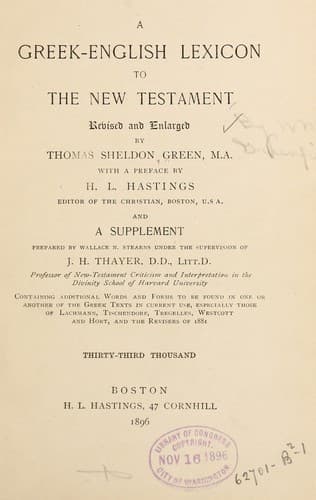
A Greek-English Lexicon to the New TestamentGreenfield, William
Religion
A Greek-English Lexicon to the New Testament
Greenfield, William
Bible. New Testament -- Dictionaries -- English; Greek language, Biblical -- Dictionaries -- English
5.29, 30; 18.10; 24.6.
Mar. 13.36; μή, οr μήτι, or μήποτε, prefixed to an interrogrative
clause is a mark of tone, since it expresses an intimation
either of the reality of the matters respecting which the
question is asked, Mat. 12.23, et al.; or the contrary,
Jno. 4.12, et al.
Μήγε, (μή & γε)
a strenthened form for μή, Mat. 6.1; 9.17, et al.
Μηδαμῶς, (μηδαμός, i.q. μηδείς)
adv. by no means, Ac. 10.14; 11.8.
Μηδέ,
conj. neither and repeated, neither—nor, Mat. 6.25; 7.6; 10.9, 10;
not even, not so much as, Mar. 2.2, et al.
Μηδείς, μηδεμίᾰ, μηδέν, (μηδέ & εἷς)
not one, none, no one, Mat. 8.4, et al.
Μηδέποτε, (μηδέ & ποτε)
not at any time, never, 2 Ti. 3.7.
Μηδέπω, (μηδέ & πω)
not yet, not as yet, He. 11.7.
Μηκέτι, (μή & ἔτι)
no more, no longer, Mar. 1.45; 2.2, et al.
Μῆκος, εος, τό,
length, Ep. 3.18. Re. 21.16:
whence
Μηκύνω,
f. υνῶ,
to lengthen, prolong; mid. to grow up, as plants, Mar. 4.27.
Μηλωτή, ῆς, ἡ, (μῆλον, a sheep)
a sheepskin, He. 11.37.
Μήν, μηνός, ὁ,
a month, Lu. 1.24, 26, 36, 53, et al.; in N.T., the new moon,
the day of the new moon, Ga. 4.10.
Μήν
a particle occuring in the N.T. only in the combination ἧ μήν. See ἧ.
Μηνύω,
f. ύσω, p. μεμήνυκα, a.1. ἐμήνυσα,
to disclose what is secret, Jno. 11.57. Ac. 23.30. 1 Co. 10.28;
to declare, indicate, Lu. 20.37.
Μήποτε, (μή & ποτε)
has the same signification and usage as μή; which see;
He. 9.17. Mat. 4.6. Mat. 13.15; also, whether, Lu. 3.15.
Μήπω, (μή & πω)
adv. not yet, not as yet, Ro. 9.11. He. 9.8.
Μήπως, (μή & πως)
conj. lest in any way or means, that in no way, Ac. 27.29.
Ro. 11.21. 11 Co. 8.9; 9.27, et al.; whether perhaps, 1 Th. 3.5.
Μηρός, οῦ, ὁ,
the thigh, Re. 19.16.
Μήτε, (μή & τε)
conj. neither, μήτε—μήτε, v. μὴ—μήτε, v. μηδὲ—μήτε,
neither—nor, Mat. 5.34, 35, 36. Ac. 23.8. 2 Th. 2.2;
in N.T., also equivalent to μηδέ, not even,
not so much as, Mar. 3.20.
Μήτηρ, τέρος, τρός, ἡ,
a mother, Mat. 1.18; 12.49, 59, et al. freq.;
a parent city, Ga. 4.26. Re. 17.5.
Μήτι, (μή & τι)
has the same use as μή in the form εἰ μήτι,
Lu. 9.13, et al.; also when prefixed to an interrogative
clause, Mat. 7.16. Jno. 4.29. See μή.
Μήτιγε, (μήτι & γε)
strengthened for μήτι, surely then, much more then,
1 Co. 6.3.
Μήτρα, ας, ἡ, (μήτηρ)
the womb, Lu. 2.23. Ro. 4.19.
Μητραλοίας, v. -λῴας, ου, ὁ,
(μήτι & ἀλοιάω, poet. for ἀλοάω, to smite)
a striker of his mother, matricide, 1 Ti. 1.9.
Μία,
see in εἷς.
Μιαίνω,
f. ανῶ, a.1. ἐμίηνα & ἐμίᾱνα, p. μεμίαγκα, p. pass. μεμίασμαι,
a.1. pass. ἐμιάνθην,
pr. to tinge, dye, stain; to pollute, defile, ceremonially,
Jno. 18.28; to corrupt, deprave, Tit. 1.15. He. 12.15. Jude 8:
whence
Μίασμα, ατος, τό,
pollution, moral defilement, 2 Pe. 2.10.
Μιασμός, οῦ, ὁ,
pollution, defiling, 2 Pe. 2.10. L.G.
Μίγμα, or μῖγμα, ατος, τό,
a mixture, Jno. 19.39:
from
Μίγνυμι & νύω,
f μίξω, a.1. ἔμιξα, p. pass. μέμιγμαι,
Public-domain text, read in full here on John Shaqi.
Reviews
Reviews
No reviews yet
Be the first to share your thoughts on this work.
Elsewhere in the archive
Join the Discussion
Join the discussion
Sign in to leave a comment or review.
Sign InorCreate an account