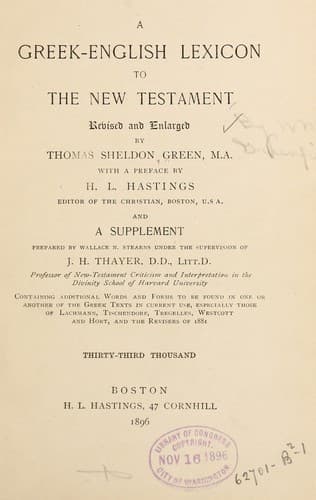
A Greek-English Lexicon to the New TestamentGreenfield, William
Religion
A Greek-English Lexicon to the New Testament
Greenfield, William
Bible. New Testament -- Dictionaries -- English; Greek language, Biblical -- Dictionaries -- English
12.18; 15.2; ἐν ὀλίγῳ, concisely, briefly,
Ep. 3.3; almost, Ac. 26.28, 29.
Ὀλιγόψῡχος, ου, ὁ, ἡ, (ὀλίγος & ψυχή)
faint-hearted, desponding, 1 Th. 5.14. L.G.
Ὀλιγωρέω, ῶ, (ὀλίγος & ὤρα, care)
f. ήσω,
to neglect, regard slightly, make light of, despise,
contemn, He. 12.5.
Ὀλίγως, (ὀλίγος)
adv. a little, scarcely, v.r. 2 Pe. 2.18.
Ὀλοθρευτής, οῦ, ὁ,
a destroyer, 1 Co. 10.10: (N.T.) from
Ὀλοθρεύω, (ὄλεθρος)
f. εύσω,
to destroy, cause to perish, He. 11.28. S.
Ὁλοκαύτωμα, ατος, τό, (ὁλοκαυτόω, to offer a whole burnt offering,
ὁλόκαυτος, ὅλος & καίω)
a holocaust, whole burnt offering, Mar. 12.33. He. 10.6, 8. S.
Ὀλοκηρία, ας, ἡ,
perfect soundness, Ac 3.16: (S.) from
Ὁλόκληρος, ου, ὁ, ἡ, (ὅλος & κλῆρος)
whole, having all its parts, sound, perfect, complete in
every part; in N.T., the whole, 1 Th. 5.23; morally, perfect,
faultless, blameless, Ja. 1.4.
Ὀλολύζω,
f. ξω, a.1. ὠλόλυξα,
pr. to cry aloud in invocation; to howl, utter cries of
distress, lament, bewail, Ja. 5.1.
Ὅλος, η, ον,
all, whole, entire, Mar. 1.22; 4.23, 24, et al. freq.
Ὁλοτελής, έος, ὁ, ἡ, (ὅλος & τελος)
complete; all, the whole, 1 Th. 5.13.
Ὅλυνθος, ου, ὁ,
an unripe or unseasonable fig, such as lying under the foliage,
do not ripen at the usual season, but hang on the trees during
winter, Re. 6.13.
Ὅλως, (ὅλος)
adv. wholly, altogether; actually, really, re vera,
1 Co. 5.1; 6.7; 15.29; with a negative, at all, Mat. 5.34.
Ὄμβρος, ου, ὁ, (Lat. imber)
rain, a storm of rain, Lu. 15.54.
Ὁμείρομαι,
to desire earnestly, have a strong affection for, v.r. 1 Th. 2.8.
Ὁμῑλέω, ῶ,(ὅμιλος)
f. ήσω,
to be in company with, associate with; to converse with,
talk with, Lu. 24.14, 15. Ac. 20.11; 24.26.
Ὁμῑλία, ας, ἡ,
intercourse, communication, converse, 1 Co. 15.33:
from
Ὁμιλος, ου, ὁ, (ὁμοῦ, & ἴλη, a band)
a multitude, company, crowd, Re. 18.17.
Ὁρίχλη, ης, ἡ,
a mist, fog; a cloud, v.r. 2 Pe. 2.17.
Ὄμμα, ατος, τό,
the eye, Mar. 8.23.
Ὀμνύω, v. ὄμνῡμι,
f. ὀμοῦμαι, p. ὀμώμοκα, a.1. ὤμοσα,
to swear, Mat. 5.24, et al.; to promise with an oath,
Mar. 6.23. Ac. 2.30; 7.17, et al. (ῠ).
Ὁμοθυμᾰδόν, (ὁμοῦ & θυμός)
adv. with one mind, with one accord, unanimously,
Ac. 1.14. Ro. 15.6; together, at once, at the same time,
Ac. 2.1, 46; 4.24, et al.
Ὁμοιάζω, (ὅμοιος)
f. άσω,
to be like, resemble, Mar. 14.70. N.T.
Ὁμοιοπᾰθής, έος, οῦς, ὁ, ἡ, (ὅμοιος & πάθος)
being affected in the same way as another, subject
to the same incidents, of like infirmities, obnoxious
to the same frailties and evils, Ac. 14.14. Ja. 15.17.
Ὅμοιος, οία, οιον, (ὁμός)
like, similar, resembling,
Mat. 11.16; 13.31, 33, 44, 45, 47, 52.
Jno. 8.55, et al. freq.; like, of similar drift
and force, Mat. 22.39. Mar. 12.31:
whence
Ὁμοιότης, τητος, ἡ
likeness, similitude, He. 4.15; 7.15.
Ὁμοιόω, ῶ,
f. ώσω, a.1. ὡμοίωσα,
to make like, cause to be like or resemble, assimilate;
pass.
Public-domain text, read in full here on John Shaqi.
Reviews
Reviews
No reviews yet
Be the first to share your thoughts on this work.
Elsewhere in the archive
Join the Discussion
Join the discussion
Sign in to leave a comment or review.
Sign InorCreate an account