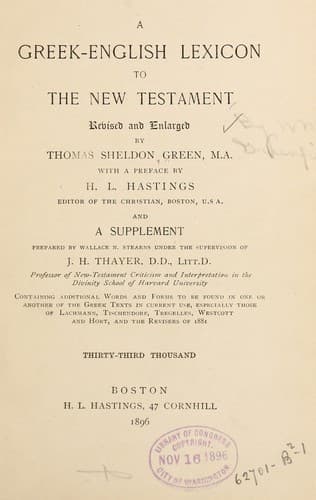
A Greek-English Lexicon to the New TestamentGreenfield, William
Religion
A Greek-English Lexicon to the New Testament
Greenfield, William
Bible. New Testament -- Dictionaries -- English; Greek language, Biblical -- Dictionaries -- English
Παγιδεύω,
f. εύσω,
to ensnare, entrap, entangle Mat. 22.15:
from
Παγίς, ίδος, ἡ, (πήγνυμι)
a snare, trap, gin, Lu 21.35; met. artifice, stratagem,
device, wile, 1 Ti. 3.7; 6.9. 2 Ti. 2.26;
met. source of harm, Ro. 11.9.
Πάγος, ου, ὁ, (fr. same)
a hill; Ἄρειος πάγος, Areopagus, the hill of Mars at Athens,
Ac. 17.19, 22.
Πάθημα, ατος, τό, (πάσχω)
what is suffered; suffering, affliction, Ro. 8.18.
2 Co. 1.5, 6, 7. Ph. 3.10, et al.; emotion, passion,
Ro. 7.5. Ga. 5.24.
Παθητός, οῦ, ὁ, ἡ, (fr. same)
passible, capable of suffering, liable to suffer; in N.T.,
destined to suffer, Ac. 26.23.
Πάθος, εος, τό, (fr. same)
suffering; an affection, passion, Ro. 1.26.
Παιδαγωγός, οῦ, ἡ, (παῖς & ἀγωγός, ἄγω)
a pedagogue, child-tender, a person, usually a slave or freedman,
to whom the boys of a family were committed, whose duty it was
to attend them at their play, lead them to and from the public
school, and exercise a constant superintendence over their conduct
and safety; in N.T., an ordinary director or minister contrasted
with an Apostle, as a pedagogue occupies an inferior position
to a parent, 1 Co. 4.15; a term applied to the Mosaic Law as
dealing with men as in a state of mere childhood and tutelage,
Ga. 3.24, 25.
Παιδάριον, ίου, τό, (dimin. of παῖς)
a little boy, child, a boy, lad, Mat. 11.16. Jno 6.9.
Παιδεία, ας, ἡ, (παιδεύω)
education, training up, nurture of children, Ep. 6.4;
instruction, discipline, 2 Ti. 3.16; in N.T., correction,
chastisement, He. 12.5, 7, 8, 11.
Παιδευτής, οῦ, ὁ,
a preceptor, instructor, teacher, pr. of boys; genr. Ro. 2.20;
a chastiser, He. 12.9:
from
Παιδεύω, (παῖς)
f. εύσω, a.1. ἐπαίδευσα,
to educate, instruct children, Ac. 7.22; 22.3;
genr. παιδεύομαι, to be taught, learn, 1 Ti. 1.20;
to admonish, instruct by admonition, 2 Ti. 2.25.
Tit. 2.12; in N.T., to chastise, chasten,
1 Co. 11.32. 2 Co. 6.9. He. 12.6, 7, 10. Re. 3.19;
of criminals, to scourge, Lu. 23.16, 22.
Παιδιόθεν,
adv. from childhood, from a child, Mar. 9.21: (N.T.)
from
Παιδίον, ου, τό, (dimin. of παῖς)
an infant, babe, Mat. 2.8, et al.; but usually in N.T.
as equiv. to παῖς, Mat. 14.21. Mar. 7.28. et al. freq;
pl. voc. used by way of endearment, my dear children,
1 Jno. 2.18, et al.; also as a term of familiar address,
children, my lads, Jno. 21.5.
Παιδίσκη, ης, ἡ, (fem. dim. of παῖς)
a girl, damsel, maiden; a female slave or servant,
Mat. 26.69. Mar. 14.66, 69, et al.
Παίζω,
f. παίξομαι,
to play in the manner of children; to sport, to practise
the festive gestures of idolatrous worship, 1 Co. 10.7:
from
Παῖς, παιδός, ὁ, ἡ,
a child in relation to parents, of either sex, Jno. 4.51, et al.;
a child in respect of age, either male or female, and of all
ages from infancy up to manhood, a boy, youth, girl, maiden,
Mat. 2.16; 17.18. Lu. 2.43; 8.54; a servant, slave,
Mat. 8.6, 8, 13, cf. v.9. Lu. 7.7. cf v.3, 10; an attendant,
minister, Mat. 14.2. Lu.
Public-domain text, read in full here on John Shaqi.
Reviews
Reviews
No reviews yet
Be the first to share your thoughts on this work.
Elsewhere in the archive
Join the Discussion
Join the discussion
Sign in to leave a comment or review.
Sign InorCreate an account