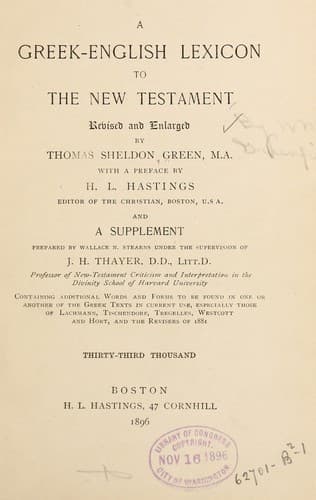
A Greek-English Lexicon to the New TestamentGreenfield, William
Religion
A Greek-English Lexicon to the New Testament
Greenfield, William
Bible. New Testament -- Dictionaries -- English; Greek language, Biblical -- Dictionaries -- English
ιῶ, p. πεπότικα, α.1. ἐπότισα,
to cause to drink, give drink to, Mat. 10.42, et al.;
met. 1 Co. 3.2. Re. 14.8; to water, irrigate,
met. 1 Co. 3.6, 7, 8.
Πότος, ου, ὁ, (πίνω)
a drinking; a drinking together, drinking-bout,
compotation, 1 Pe. 4.3.
Που
an enclitic indefinite particle, somewhere, in a certain place,
He. 2.6; 4.4; with numerals, thereabout, Ro. 4.19.
Ποῦ
an interrog. particle, of place, where? in what place?;
direct, Mat. 2.2. Lu. 8.25. Jno 1.39;
indirect, Mat. 2.4. Jno 1.40;
whither, Jno. 3.8; 7.35; 13.36.
Πούς, ποδός, ἡ
the foot, Mat. 4.6; 5.35; 7.6; 22.44; 28.9.
Lu. 1.79. Ac. 5.9. Ro. 3.15, et al.
Πρᾶγμα, ατος, τό, (πράσσω)
a thing done, fact, deed, work, transaction, Lu. 1.1. Ja. 3.16;
a matter, affair, Mat. 18.19. Ro. 16.2;
a matter of dispute, 1 Co. 6.1;
a thing, genr., He. 10.1; 11.1;
τὸ πρᾶγμα, an euphemism for profligacy, perhaps, 1 Th. 4.6.
Πραγματεία, ας, ἡ,
an application to a matter of business; in N.T.,
business, affair, transaction, 2 Ti. 2.4:
from
Πραγματεύομαι, (πρᾶγμα)
f. ευσομαι,
to be occupied with or employed in any business, do business;
to trade, traffic, Lu. 19.13.
Πραιτώριον, ίον, τό, (Lat. prætorium, fr. prætor)
when used in reference to a camp, the tent of the general
or commander-in-cheif; hence, in reference to a province,
the palace in which the governor of the province resided,
Mat. 27.27. Mar. 15.16. Ac. 23.35, et al.;
the camp occupied by the prætorian cohorts at Rome,
the prætorian camp, or, the Roman emperor's palace, Phi. 1.13.
Πράκτωρ, ορος, ὁ, (πράσσω)
an exactor of dues or penalties; an officer who enforced
payment of debts by imprisonment, Lu. 12.58.
Πρᾶξις, εως, ἡ, (fr. same)
operation, business, office, Ro. 12.4; πρᾶξις & πράξεις,
actions, mode of acting, ways, deeds, practice, behaviour,
Mat. 16.27. Lu. 23.51, et al.
Πρᾶος, εῖα, ον,
mild; gentle, kind, Mat. 11.29:
whence
Πραότης, τητος, ἡ,
meekness, forbearance, 1 Co. 4.21. Ga. 5.23;
gentleness, kindness, benevolence, 2 Co. 10.1, et al.
Πρασιά, ᾶς, ἡ,
a small area or bed in a garden;
trop. a company of persons disposed in squares;
fr. the Heb. πρασιαὶ προσιαί, by areas, by squares,
like beds in a garden, Mar. 6.40.
Πράσσω, v. ττω,
f. ξω, p. πέπρᾱχα, a.1. ἔπραξα,
to do, execute, perform, practise, act, transact,
and of evil, to commit, Lu. 22.23; 23.15. Jno 3.20.
Ac. 26.9, 20, 26, 31, et al.; to fulfil, obey,
observe a law, Ro. 2.25; to do to any one, Ac. 16.28; 5.35;
to occupy one's self with, be engaged in, busy one's self
about, Ac. 19.19. 1 Th. 4.11; to fare, Ac. 15.29. Ep. 6.21;
to exact, require, collect tribute, money lent, &c.
Lu. 3.13; 19.23.
Πραϋπάθεια, ας, ἡ, (πραΰς & πάθος, fr. πάσχω)
meekness, gentleness of mind, kindness, v.r. 1 Ti. 6.11. L.G.
Πραΰς, εῖα, ύ, έος, οῦς, είας, έος, οῦς, i.q. πρᾶος,
meek, gentle, kind, forgiving, Mat. 5.5;
mild, benevolent, humane, Mat. 21.5. 1 Pe. 3.4:
whence
Πραΰτης, τητος, ἡ, i.q.
Public-domain text, read in full here on John Shaqi.
Reviews
Reviews
No reviews yet
Be the first to share your thoughts on this work.
Elsewhere in the archive
Join the Discussion
Join the discussion
Sign in to leave a comment or review.
Sign InorCreate an account