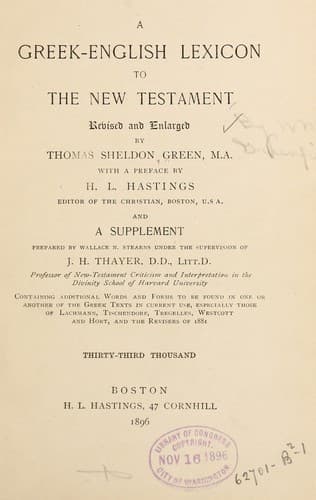
A Greek-English Lexicon to the New TestamentGreenfield, William
Religion
A Greek-English Lexicon to the New Testament
Greenfield, William
Bible. New Testament -- Dictionaries -- English; Greek language, Biblical -- Dictionaries -- English
Mat. 26.71.
Προβαίνω, (πρό & βαίνω)
f. βήσομαι, a.2. προὔβην, part. προβάς,
to go forward, advance, Mat. 4.21. Mar. 1.19;
to advance in life, Lu. 1.7, 18; 2.36.
Προβάλλω, (πρό & βάλλω)
f. βαλῶ, a.2. προὔβαλον,
to cast before, project; to put or urge forward,
Ac. 19.33; to put forth, as a tree its blossoms, &c.
Lu. 21.30.
Προβατικός, ή, όν,
belonging or pertaining to sheep; ἡ προβατικὴ (πύλη)
the sheep-gate, Jno. 5.2:
from
Πρόβᾰτον, ου, τό,
a sheep, Mat. 7.15; 9.36; 10.16;
met. Mat. 10.6; 15.24, et al.
Προβιβάζω, (πρό & βιβάζω)
f. άσω,
to cause any one to advance, to lead forward;
to advance, push forward, Ac. 19.33;
met. to incite, instigate, Mat. 14.8.
Προβλέπω, (πρό & βλέπω)
f. ψω,
to foresee; mid. to provide beforehand, He. 11.40. S.
Προγίνομαι, (πρό & γίνομαι)
p. προγέγονα,
to be or happen before, be previously done or committed;
προγεγονώς, bygone, previous, Ro. 3.25.
Προγινώσκω, (πρό & γινώσκω)
f. γνώσομαι, a.2. προέγνων, p. pass. προέγνωσμαι,
to know beforehand, to be previously acquainted with,
Ac. 26.5. 2 Pe. 3.17;
to determine on beforehand, to fore-ordain,
1 Pe. 1.20; in N.T.,
fr. the Heb., to foreknow, to appoint as the subjects of
future privileges, Ro. 8.29; 11.2:
whence
Πρόγνωσις, εως, ἡ,
foreknowledge, prescience; in N.T., previous determination,
purpose, Ac. 2.23. 1 Pe. 1.2.
Πρόγονος, ου, ὁ, (προγίνομαι)
born earlier, elder; a progenitor,
pl. progenitors; parents, 1 Ti. 5.4;
forefathers, ancestors, 2 Ti. 1.3.
Προγράφω, (πρό & γράφω)
f. ψω, p. pass. προγεγράμμαι, a.2. pass. προεγράφην
to write before or aforetime, Ro. 15.4. Ep. 3.3;
to make a subject of public notice;
to set forth unreservedly and distinctly, Ga. 3.1;
to designate clearly, Jude 4.
Πρόδηλος, ου, ὁ, ἡ, τό, -ον, (πρό & δῆλος)
previously manifest, before known;
plainly manifest, very clear, prominently conspicuous,
1 Ti. 5.24, 25. He. 7.14.
Προδίδωμι, (πρό & δίδωμι)
f. δώσω,
to give before, precede in giving, Ro. 11.35;
to give up, abandon, betray:
whence
Προδότης, ου, ὁ,
a betrayer, traitor, Lu 6.16. Ac. 7.52. 2 Ti. 3.4.
Πρόδρομος, ου, ὁ, ἡ, (δραμεῖν)
a precursor, forerunner, one who advances to explore
and prepare the way, He. 6.20.
Προεῖδον,
part. προῐδών, 2. aor. of προοράω:
which see.
Προεῖπα,
1. aor. & προεῖπον, 2. aor., of προλέγω:
which see.
Προείρηκα,
perf. of προλέγω.
Προελπίζω, (πρό & ἐλπίζω)
f. ίσω,
to repose hope and confidence in a person or
thing beforehand, Ep. 1.12.
Προενάρχομαι, (πρό & ἐνάρχομαι)
f. ξομαι,
to begin before a particular time, 2 Co. 8.6, 10. N.T.
Προεπαγγέλλομαι, (πρό & ἐπαγγέλλομαι)
a. 1. προεπηγγειλάμην,
to promise beforehand, or aforetime, Ro. 1.2. L.G.
Προέρχομαι, (πρό & ἔρχομαι)
f. ελεύσομαι, a.2. προῆλθον
to go forwards, advance, proceed, Mat. 26.39. Mar. 14.35. Ac. 12.10;
to precede, go before any one, Lu. 22.47;
Public-domain text, read in full here on John Shaqi.
Reviews
Reviews
No reviews yet
Be the first to share your thoughts on this work.
Elsewhere in the archive
Join the Discussion
Join the discussion
Sign in to leave a comment or review.
Sign InorCreate an account