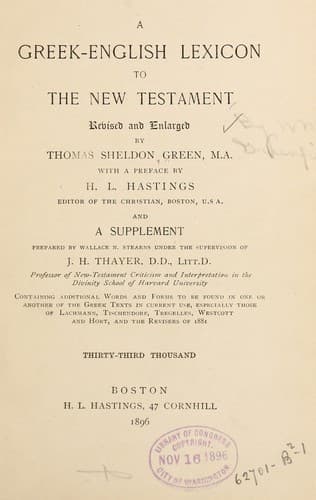
A Greek-English Lexicon to the New TestamentGreenfield, William
Religion
A Greek-English Lexicon to the New Testament
Greenfield, William
Bible. New Testament -- Dictionaries -- English; Greek language, Biblical -- Dictionaries -- English
to constantly attend upon, continue near to, be at hand,
Mar. 3.9. Ac. 8.13; 10.7:
whence
Προσκαρτέρησις, εως, ἡ
perseverance, unremitting continuance in a thing, Ep. 6.18. N.T.
Προσκεφάλαιον, ου, τό, (πρός & κεφαλή)
pr. a cushion for the head, pillow; also, a boat-cushion, Mar. 4.38.
Προσκληρόω, ῶ, (πρός & κληρόω)
f. ώσω,
pr. to assign by lot; in N.T.,
mid. a.1. προσεκληρώθην, to adjoin one's self to,
associate with, follow as a disciple, Ac. 17.4.
Προσκλίνω, (πρός & κλίνω)
f. ινῶ,
pr. to make to lean upon or against a thing;
met., mid. προσεκλίθην, to join one's self to, follow as an adherent,
v.r. Ac. 5.36:
whence
Πρόσκλῐσις, εως, ἡ,
pr. a leaning upon or towards a thing;
met. a leaning towards any one, inclination of mind towards,
partiality, 1 Ti. 5.21. L.G.
Προσκολλάω, ῶ, (πρός & κολλάω)
f. ήσω,
pr. to glue to; in N.T.,
mid., a.1. προσεκολλήθη f. προσκολληθήσομαι,
to join one's self to any one, follow as an adherent, Ac. 5.36;
to cleave closely to, Mat. 19.5. Mar. 10.7. Ep. 5.31.
Πρόσκομμα, ατος, τό, (προσκόπτω)
a stumbling, Ro. 9.32, 33. 1 Pe. 2.8;
met. a stumbling-block, an occasion of sinning,
means of inducing to sin, Ro. 14.13. 1 Co. 8.9;
met. a moral stumbling, a shock to the moral or religious sense,
a moral embarrassment, Ro. 14.20. L.G.
Προσκοπή, ῆς, ἡ,
pr. a stumbling; offence, in N.T.,
an offence, shock, ground of exception, 2 Co. 6.3:
from
Προσκόπτω, (πρός & κόπτω)
f. ψω,
to dash against, to beat upon, Mat. 7.27;
to strike the foot against, Mat. 4.6. Lu. 4.11;
to stumble, Jno 11.9, 10;
met. to stumble at, to take offence at, Ro. 9.32; 14.21, 1 Pe. 2.8.
Προσκυλίω, v. προσκυλίνδω, (πρός & κυλίω)
f. ίσω,
to roll to or against, Mat. 27.60. Mar. 15.46. (ῑ.)
Προσκυνέω, ῶ, (πρός & κυνέω, to kiss)
f. ήσομαι, & ήσω, a.1. προσεκύνησα,
to do reverence or homage by kissing the hand; in N.T.,
to do reverence or homage by prostration,
Mat. 2.2, 8, 11; 20.20. Lu. 4.7; 24.52;
to pay divine homage, worship, adore,
Mat. 4.10. Jno. 4.20, 21. He. 1.6, et al.;
to bow one's self in adoration, He. 11.21:
whence
Προσκυνητής, οῦ, ὁ,
a worshipper, Jno. 4.23. N.T.
Προσλᾰλέω, ῶ, (πρός & λαλέω)
f. ήσω,
to speak to, converse with, Ac. 13.43; 28.20. L.G.
Προσλαμβάνω, (πρός & λαμβάνω)
to take besides; mid. προσλαμβάνομαι, f. λήψομαι,
to take to one's self, assume, take as a companion or associate,
Ac. 17.5; 18.26;
to take, as food, Ac. 27.33, 34, 36;
to receive kindly or hospitably, admit to one's society and
friendship, treat with kindness,
Ac. 28.2. Ro. 14.1, 3; 15.7. Phile. 12, 17;
to take or draw to one's self as a preliminary
to an address of admonition, Mat. 16.22. Mar. 8.32:
whence
Πρόσληψις, εως, ἡ
an assuming; a receiving, reception, Ro. 11.15.
Προσμένω, (πρός & μένω)
f. ενῶ,
to continue, remain, stay in a place, 1 Ti. 1.3;
to remain or continue with any one, Mat. 15.32. Mar. 8.2. Ac. 18.18;
to adhere to, Ac. 11.23;
Public-domain text, read in full here on John Shaqi.
Reviews
Reviews
No reviews yet
Be the first to share your thoughts on this work.
Elsewhere in the archive
Join the Discussion
Join the discussion
Sign in to leave a comment or review.
Sign InorCreate an account