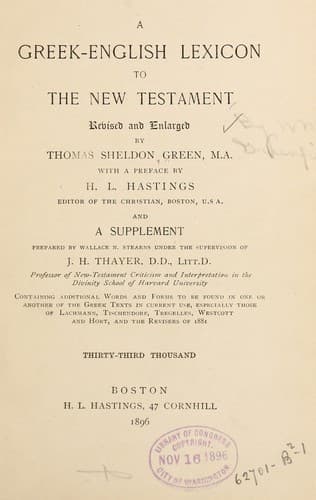
A Greek-English Lexicon to the New TestamentGreenfield, William
Religion
A Greek-English Lexicon to the New Testament
Greenfield, William
Bible. New Testament -- Dictionaries -- English; Greek language, Biblical -- Dictionaries -- English
worn by priests, kings, and persons of distinction,
Mat. 12.38; 16.5. et al.
Στόμα, ατος, τό,
the mouth, Mat. 12.34; 15.11, 17, 18; 21.16, et al.;
speech, words, Mat. 18.16. 2 Co. 13.1;
command of speech, facility of language, Lu. 21.15;
fr. Heb. ἀνοίγειν τὸ στόμα, to make utterance,
to speak, Mat. 5.2; 13.35, et al.;
also, used of the earth, to rend, yawn,
Re. 12.16; στόμα πρὸς στόμα λαλεῖν, to speak mouth to mouth,
face to face, 2 Jno. 12. 3 Jno. 14;
the edge of point of a weapon, Lu. 21.24. He. 11.34.
Στόμᾰχος, ου, ὁ, (στόμα)
pr. the gullet leading to the stomach; hence,
later, the stomach itself, 1 Ti. 5.23.
Στρατεία, ας, ἡ, (στρατεύω)
a military expedition, campaign; and
genr. military service, warfare;
met. the Christian warfare, 2 Co. 10.4. 1 Ti. 1.18.
Στράτευμα, ατος, τό,
an army, Mat. 22.7, et al.;
an armed force, corps, Ac. 23.10, 27;
troops, guards, Lu. 23.11:
from
Στρατεύω, (στρατός, an army)
f. εύσω, & mid. στρατεύομαι,
to perform military duty, serve as a soldier,
Lu. 3.14. 1 Co. 9.7. 2 Ti. 2.4;
to battle, Ja. 4.1. 1 Pe. 2.11;
to be spiritually militant, 2 Co. 10.3. 1 Ti. 1.18.
Στρατηγός, οῦ, ὁ, (στρατός & ἄγω)
a leader or commander of an army, general;
a Roman prætor, provincial magistrate,
Ac. 16.20, 22, 35, 36, 38; στρατηγὸς τοῦ ἱεροῦ,
the captain or prefect of the temple,
the chief of the Levites who kept guard in and around the temple,
Lu. 22.4, 52. Ac. 4.1; 5.24, 26.
Στρατιά, ᾶς, ἡ, (στρατός)
an army, host; fr. Heb. στρατιὰ οὐράνιος, v. τοῦ οὐρανοῦ,
the heavenly host, the host of heaven, the hosts of angels,
Lu. 2.13; the stars, &c., Ac. 7.42:
whence
Στρατιώτης, ου, ὁ
a soldier, Mat. 8.9; 27.27, et al.;
met. a soldier of Christ, 2 Ti. 2.3.
Στρατολογέω, ῶ, (στρατός & λέγω)
f. ήσω,
to collect or levy an army, enlist troops,
2 Ti. 2.4. L.G.
Στρατοπεδάρχης, ου, ὁ, (στρατόπεδον & ἄρχω)
a commandant of a camp; a legionary tribune;
perhaps the prefect of the prætorian camp,
Ac. 28.16. L.G.
Στρατόπεδον, (στρατός & πέδον)
pr. the site of an encampment; an encampment;
meton. an army, Lu. 21.20.
Στρεβλόω, ῶ,
(στρεβλή, a windlass, a wrench, instrument of torture, rack)
f. ώσω,
pr. to distort the limbs on a rack;
met. to wrench, distort, pervert, 2 Pe. 3.16.
Στρέφω,
f. ψω, a.1. ἔστρεψα, a.2. pass. ἐστράφην,
to twist; to turn, Mat. 5.39;
to make a change of substance, to change, Re. 11.6;
absol. to change or turn one's course of dealing, Ac. 7.42;
mid. to turn one's self about, Mat. 16.23. Lu. 7.9, et al.;
to turn back, Ac. 7.39; to change one's direction,
to turn elsewhere, Ac. 13.46;
to change one's course of principle and conduct,
to be converted, Mat. 18.3.
Στρηνιάω, ῶ,
f. άσω,
to be wanton, to revel, riot, Re. 18.7, 9:
from
Στρῆνος, εος, τό, (στρηνής, strong, hard)
headstrong pride; wantonness, luxury, voluptuousness, Re. 18.3.
Στρουθίον, ίου, τό, (dimin. of στρουθός)
any small bird, spc. a sparrow, Mat.
Public-domain text, read in full here on John Shaqi.
Reviews
Reviews
No reviews yet
Be the first to share your thoughts on this work.
Elsewhere in the archive
Join the Discussion
Join the discussion
Sign in to leave a comment or review.
Sign InorCreate an account