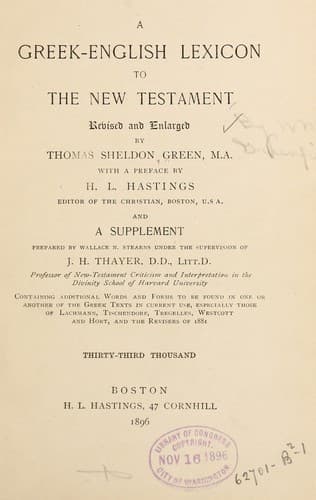
A Greek-English Lexicon to the New TestamentGreenfield, William
Religion
A Greek-English Lexicon to the New Testament
Greenfield, William
Bible. New Testament -- Dictionaries -- English; Greek language, Biblical -- Dictionaries -- English
Συσταυρόω, ῶ, (σύν & σταυρόω)
f. ώσω, p. pass. συνεσταύρωμαι, a.1. συνεσταυρώθην,
to crucify with another, Mat. 27.44. Mar. 15.32. Jno. 19.32;
pass. met. to be crucified with another in a spiritual
resemblance, Ro. 6.6. Ga. 2.20. N.T.
Συστέλλω, (σύν & στέλλω)
f. ελῶ, a.1. συνέστειλα, p. pass. συνέσταλμαι,
to draw together, contract, straiten; to enwrap;
hence, i.q. περιστέλλω, to lay out, prepare for burial, Ac. 5.6;
pass. to be shortened, or, to be environed with trials, 1 Co. 7.29.
Συστενάζω, (σύν & στενάζω)
f. ξω,
to groan altogether, Ro. 8.22.
Συστοιχέω, ῶ, (σύν & στοιχέω)
f. ήσω,
pr. to be in the same row with; met. to correspond to, Ga. 4.25.
Συστρατιώτης, ου, ὁ, (σύν & στρατιώτης)
a fellow-soldier; met. a fellow-soldier, co-militant, in the service of Christ, Phi. 2.25. Phile. 2.
Συστρέφω, (σύν & στρέφω)
f. ψω,
to turn or roll together; to collect, gather, Ac. 28.3:
whence
Συστροφή, ῆς, ἡ,
a gathering, concourse, tumultuous assembly, Ac. 19.40;
a combination, conspiracy Ac. 23.12, col. v.13.
Συσχηματιζω, (σύν & σχηματίζω, to form, fr. σχῆμα)
to fashion in accordance with;
mid. to conform or assimilate one's self to,
met. Ro. 12.2. 1 Pe. 1.14.
Σφαγή, ῆς, ἡ, (σφάζω)
slaughter, Ac. 8.32. Ro. 8.36. Ja. 5.5.
Σφάγιον, ου, τό,
a victim slaughtered in sacrifice, Ac. 7.42:
from
Σφάζω, v. Att. σφάττω,
f. ξω, a.1. ἔσφαξα, a.2. pass. ἐσφάγην, p. pass. ἔσφαγμαι,
to slaughter, kill, slay;
pr. used of animals killed in sacrifice, &c., Re. 5.6, 9, 12; 13.8;
of persons, &c., 1 Jno. 3.12. Re. 6.4, 9; 18.24;
to wound mortally, Re. 13.3.
Σφόδρα, (pr. neut. pl. of σφοδρός, vehement, violent, strong)
adv. much, greatly, exceedingly, Mat. 2.10; 17.6, et al.
Σφοδρῶς, (fr. same)
adv. exceedingly, vehemently, Ac. 27.18.
Σφραγίζω,
f. ίσω, a.1. ἐσφράγισα, p. pass. ἐσφράγισμαι,
a.1. pass. ἐσφραγίσθην,
to seal, stamp with a seal, Mat. 27.66;
to seal up, to close up, conceal, Re. 10.4; 22.10;
to set a mark upon, distinguish by a mark Re. 7.3, 8;
to seal, to mark distinctively as invested with a certain
character, Jno. 6.24; mid. to set one's own mark upon,
seal as one's own, to impress with a mark of acceptance, 2 Co. 1.22;
to obtain a quittance of, to deliver over safely to any one, Ro. 15.28;
absol. to set to one's seal, to make a solemn declaration, Jno. 3.33:
from
Σφρᾱγίς, ῖδος, ἡ,
a seal, a signet ring, Re. 7.2;
an inscription on a seal, motto, 2 Ti. 2.19;
a seal, the impression of a seal, Re. 5.1, et al.;
a seal, a distinctive mark, Re. 9.4;
a seal, a token, proof, 1 Co. 9.2;
a token of guarantee, Ro. 4.11.
Σφυρόν, οῦ, τό,
the ankle; pl. τὰ σφυρά, the ankle bones, malleoli, Ac. 3.7.
Σχεδόν, (ἔχω, σχεῖν)
adv. pr. near of place; hence, nearly, almost,
Ac. 13.44; 19.26. He. 9.22.
Σχῆμα, ατος, τό, (fr. same)
fashion form; fashion, external show, 1 Co. 7.31;
guise, appearance, Phi. 2.8.
Σχίζω,
f. ίσω, a.1. ἔσχισα, a.1. pass. ἐσχίσθη,
Public-domain text, read in full here on John Shaqi.
Reviews
Reviews
No reviews yet
Be the first to share your thoughts on this work.
Elsewhere in the archive
Join the Discussion
Join the discussion
Sign in to leave a comment or review.
Sign InorCreate an account