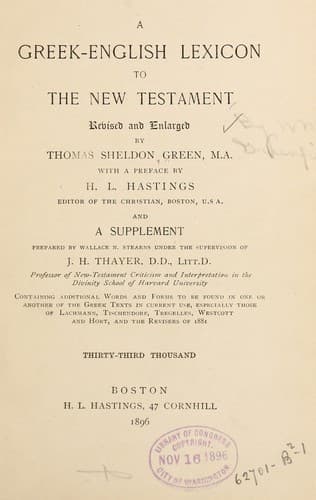
A Greek-English Lexicon to the New TestamentGreenfield, William
Religion
A Greek-English Lexicon to the New Testament
Greenfield, William
Bible. New Testament -- Dictionaries -- English; Greek language, Biblical -- Dictionaries -- English
a numerous and powerful sect of the Jews, distinguished
for their ceremonial observances, and apparent sanctity
of life, and for being rigid interpreters of the Mosaic law;
but who not unfrequently violated its spirit by their
tranditional interpretations and precepts, to which they
ascribed nearly an equal authority with the O.T.
Scriptures, Mat. 5.31, 20; 12.2; 23.14, et al.
Φαρμακεία, ας, ἡ (φάρμακον, a drug)
employment of drugs for any purpose; sorcery, magic,
enchantment, Ga. 5.20. Re. 9.21; 18.23.
Φαρμᾰκεύς, έως, ὁ, (fr. same)
pr. one who deals in drugs; an enchanter, magician,
sorcerer, Ac. 21.8.
Φαρμᾰκός, οῦ, ὁ,
a sorcerer, Re. 21.8; 22.15.
Φάσις, εως, ἡ, (φημί)
report, information, Ac. 21.31.
Φάσκω, equivalent to φημί,
imperf. ἔφασκον,
to assert, affirm, Ac. 24.9; 25.19. Ro. 1.22. Re. 2.2.
Φάτνη, ης, ἡ,
a manger, crib, Lu. 2.7, 12, 16; 13.15.
Φαῦλος, η, ον,
sorry, vile, refuse; evil, wicked,
Jno. 3.20; 5.29. Tit. 2.8. Ja. 3.16.
Φέγγος, εος, τό,
light, splendour, Mat. 24.29. Mar. 13.24. Lu. 11.33.
Φείδομαι,
f. φείσομαι
to spare, be thrifty of; to spare, be tender of, Ro. 8.32;
to spare, in respect of hard dealing,
Ac. 20.29. Ro. 11.21. 1 Co. 7.28.
2 Co. 1.23; 13.2. 2 Pe. 2.4, 5;
absol. to forbear, abstain, 2 Co. 12.6:
whence
Φειδομένως,
adv. sparingly, parsimoniously, 2 Co. 9.6, bis. L.G.
Φελόνης,
see φαιλόνης.
Φέρω,
f. οἴσω, a.1. ἤνεγκα, a.2. ἤνεγκον, a.1. pass. ἠνέχθην,
to bear, carry, Mar. 2.3, et al.;
to bring, Mat. 14.11, 18, et al.;
to conduct, Mat. 17.17. Jno. 21.18, et al.;
to bear, endure, Ro. 9.22. He. 12.20; 13.13;
to uphold, maintain, conserve, He. 1.3;
to bear, bring forth, produce, Mar. 4.8. Jno. 12.24; 15.2, et al.;
to bring forward, advance, allege, Jno. 18.29. Ac. 25.7. 2 Pe. 2.11;
to offer, ascribe, Re. 21.24, 26;
absol, used of a gate, to lead, Ac. 12.10;
pass. to be brought within reach, offered, 1 Pe. 1.13;
to be brought in, to enter, He. 9.16;
to be under a moving influence, to be moved, be instinct, 2 Pe. 1.21;
mid. to rush, sweep, Ac. 2.2;
to proceed, come forth, have utterance, 2 Pe. 1.17, 18, 21;
to proceed, make progress, He. 6.1;
used of a ship, to drive before the wind, Ac. 27.15, 17.
Φεύγω,
f. ξομαι, a.2. ἔφῠγον,
absol. to flee, take to flight, Mat. 2.13; 8.33, et al.;
to shrink, stand fearfully aloof, 1 Co. 10.14;
to make escape, Mat. 23.33; trans. to shun,
1 Co. 6.18. 1 Ti. 6.11. 2 Ti. 2.22;
to escape, He. 11.34.
Φήμη, ης, ἡ,
pr. a celestial or oracular utterance;
an utterance; fame, rumour, report, Mat. 9.26. Lu. 4.14:
from
Φημί (φάω)
f. φήσω, imperf. ἔφην
to utter, tell forth; to say, speak, Mat. 8.8; 14.8; 26.34, 61;
to say, allege, affirm, Ro. 3.8, et al.
Φθάνω,
f. ήσομαι, & άσω, a.1. ἔφθασο, a.2. ἔφθην,
to be beforehand with; to outstrip, precede, 1 Th. 4.15;
absol. to advance, make progress, 2 Co. 10.14. Phi. 3.16;
to come up with, come upon, be close at hand, Mat. 12.28.
Public-domain text, read in full here on John Shaqi.
Reviews
Reviews
No reviews yet
Be the first to share your thoughts on this work.
Elsewhere in the archive
Join the Discussion
Join the discussion
Sign in to leave a comment or review.
Sign InorCreate an account