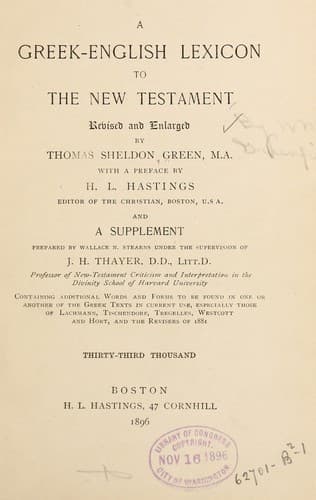
A Greek-English Lexicon to the New Testament — John Shaqi
A Greek-English Lexicon to the New TestamentGreenfield, William
Religion
A Greek-English Lexicon to the New Testament
Greenfield, William
Bible. New Testament -- Dictionaries -- English; Greek language, Biblical -- Dictionaries -- English
to wet, moisten, Lu. 7.38; to rain, cause or send rain,
Mat. 5.45. Lu. 17.29, et al.
Βροντή, ῆς, ἡ,
thunder, Mar. 3.17. Jno. 12.29, et al.
Βροχή, ῆς, ἠ (βρέχω)
rain, Mat. 7.25, 27. L.G.
Βρόχος, ου, ὁ,
a cord, noose, 1 Co. 7.35.
Βρυγμός, οῦ, ὁ,
a grating or gnashing of the teeth, Mat. 8.12; 13.42, 50, et al.:
from
Βούχω,
f. ξω,
to grate or gnash the teeth, Ac. 7.54 (ῡ).
Βρύω,
pr. to be full, to well with any thing; to emit, send forth,
Ja. 3.11.
Βρῶμα, ατος, τό, (βιβρώσκω)
food, Mat. 14.15. Mar. 7.19, et al.; solid food, 1 Co. 3.2.
Βρώσιμος, ον, ὁ, ἡ (fr. same)
eatable, that may be eaten, Lu. 24.41.
Βρῶσις, εως, ἡ,
eating, the act of eating, Ro. 14.17. 1 Co. 8.4, et al.; meat,
food, Jno. 6.27 He. 12.16; a canker or rust, æruge Mat. 6.19, 20.
Βυθίζω,
f. ίσω, a.1. ἐβύθισα,
to immerse, submerge, cause to sink, Lu. 5.17; to plunge deep,
drown, 1 Ti. 6.9:
from
Βυθός, ου, ὁ,
the bottom, lowest part; the deep, sea, 2 Co. 11.25.
Βυρσεύς, έως, ὁ (βύρσα, a hide)
a tanner, leather-dresser, Ac. 9.43; 10.6, 32. L.G.
Βύσσῐνος, η, ον,
made of byssus or fine cotton, Re. 18.16 from
Βύσσος, ου, ἡ,
byssus, a species of fine cotton highly prized by the ancients,
Lu. 16.19. v.r. Re. 18.13.
Βωμός, οῦ, ὁ,
pr. a slightly elevated spot, base, pedestal; hence, an
altar. Ac. 17.23.
Γ, γ, Γάμμα
Γάγγραινα, ης, ἡ, (γράω, γραίνω, to eat, gnaw)
gangrene, mortification, 2 Ti. 2.17.
Γάζα, ης, ἡ,
a treasure, treasury, Ac. 8.27.
Γαζοφυλάκιον, ου, τό, (γάζα & φυλακή)
a treasury; the sacred treasury, Mar. 12.41, 43. Lu. 21.1
Jno. 8.20. L.G.
Γάλα, γάλακτος, τό,
milk, 1 Co. 9.7; met. spiritual milk, the elementary parts of
Christian instruction, 1 Co. 3.2. He. 5.12, 13; spiritual nutriment,
1 Pe. 2.2
Γαλήνη, ης, ἡ,
tranquillity of the sea, a calm, Mat. 8.26. Mar. 4.39. Lu. 8.24.
Γαμέω, ῶ,
f. ῶ, &, later, ήσω, p. γεγάμηκα, a.1. ἔγημα & ἐγάμησα,
a.1. pass. ἐγαμήθην,
to marry, take a wife; to marry, enter the marriage state;
mid. to marry, be married, Mar. 10.12. 1 Co. 7.9, 10, 28, 39,
et al.;
whence
Γαμίζω,
ίσω,
to give in marriage, permit to marry, v.r. 1 Co. 7.38. N.T.
Γαμίσκομαι,
to be given in marriage, Mar. 12.25. L.G.
Γάμος, ου, ὁ,
a wedding, nuptials, the nuptial ceremonies; the attendant
festivities, Mat. 25.10. Jno. 2.1, 2. Re. 19.7, 9; any feast or
banquet, Lu. 12.36; 14.8; meton. the room in which a banquet is
held, Mat. 22.10; the marriage state, He. 13.4.
Γάρ,
a causal particle or conjunction, for; it is, however, frequently
used with an ellipsis of the clause to which it has reference, and
its force must then be variously expressed: Mat. 15.27; 27.23, et al.:
it is also sometimes epexegetic, or introductory of an intimated detail
of circumstances, now, then, to wit, Mat. 1.18.
Γαστήρ, τέρος, τρός, ἡ,
the belly, stomach; the womb, Lu. 1.13; ἐν γαστρὶ ἔχειν, to be with
child, Mat.
Public-domain text, read in full here on John Shaqi.
Reviews
Reviews
No reviews yet
Be the first to share your thoughts on this work.
Join the Discussion
Join the discussion
Sign in to leave a comment or review.
Sign InorCreate an account