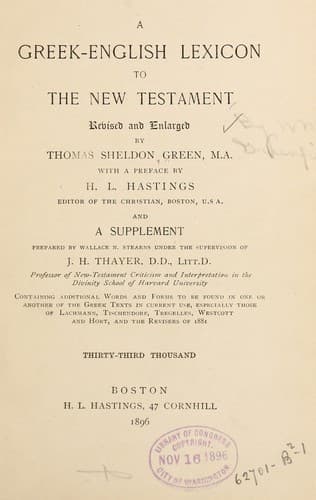
A Greek-English Lexicon to the New Testament — John Shaqi
A Greek-English Lexicon to the New TestamentGreenfield, William
Religion
A Greek-English Lexicon to the New Testament
Greenfield, William
Bible. New Testament -- Dictionaries -- English; Greek language, Biblical -- Dictionaries -- English
Βολή, ῆς, ἡ, (βάλλω)
a cast, a throw; the distance to which any thing can be
throw, Lu. 22.41.
Βολίζω,
f. ίσω, a.1. ἐβόλισα,
to heave the lead, sound, Ac. 27.28: (L.G.) from
Βολίς, ίδος, ἡ, (βάλλω)
a missile weapon, dart, javelin, He. 12.20; also a
plummet, lead for sounding. L.G.
Βόρβορος, ου, ο,
mud, mire, dung, filth, 2 Pe. 2.22.
Βοῤῥᾶς, ᾶ, ὁ, i.q. Βορέας,
pr. the north, or N.N.E. wind; meton. the north,
Lu. 13.29. Re.21.13.
Βόσκω,
f. βοσκήσω, a.1. ἐβόσκησα,
to feed, pasture, tend while grazing; βόσκομαι,
to feed, be feeding, Mat. 8.30, 33. Lu. 8.32, 34,
et al.
Βότᾰνη, ης, ἡ, (βόσκω)
herb, herbage, produce of the earth, He. 6.7.
Βότρυς, υος, ὁ,
a bunch or cluster of grapes, Re. 14.18.
Βουλευτής, ου, ὁ,
a counsellor, senator; member of the Sanhedrim, Mar. 15.43.
Lu. 23.50:
from
Βουλεύω,
f. εύσω,
to give counsel, to deliberate; mid. βουλεύομαι,
to deliberate, Lu. 14.31. Jno. 12.10. Ac. 5.33;
to purpose, determine, Ac. 15.37; 27.39. 2 Co. 1.17:
from
Βουλή, ῆς, ἡ (βούλομαι)
counsel, purpose, design, determination, decree,
Lu. 7.30; 23:51, et al. freq.; by impl. secret thoughts,
congitation of mind, 1 Co. 4.5.
Βούλημα, ατος, τό,
to purpose, will, determination, Ac. 27.43. Ro. 9.19.
Βούλομαι,
f. βουλήσομαι, imperf. ἐβουλόμην & At. ἠβουλόμην,
a.1. pass. ἐβουλήθην & ἠβουλήθην, p. βεβούλημαι,
to be willing, disposed, Mar. 15.15. Ac. 25.20; 28.18, et al.;
to intend, Mat. 1.19. Ac. 5.28; 12.4. 2 Co. 1.15; to desire,
1 Ti. 6.9; to choose, be pleased, Jno. 18.39. Ac. 18.15. Ja. 3.4;
to will, decree, appoint, Lu. 22.42. Ja. 1.18. 1 Co. 12.11.
1 Ti. 2.8; 5.14, et al.; ἐβουλόμην, I could wish, Ac. 25.22.
βουνός, οῦ, ὁ,
a hill, hillock, rising ground, Lu. 3.5; 23.30.
Βοῦς, βοός, ὁ, ἡ,
an ox, a bull or cow, an animal of the ox kind, Lu. 13.15, et al.
Βραβεῖον, ου, τό, (βραβεύς, a judge or arbiter in the public games)
a prize bestowed on victors in the public games, such as a
crown, wreath, chaplet, garland, &c. 1 Co. 9.24. Phi. 3.14. L.G.
Βραβεύω, (fr. same)
f. εύσω,
pr. to be a director, or arbiter in the public games; in N.T.
to preside, direct, rule, govern, be predominant, Col. 3.15.
Βραδύνω, (βραδύς)
f. υνῶ,
to be slow, to delay, be behindhand, 1 Ti. 3.15. 2 Pe. 3.9.
Βραδυπλοέω, ῶ,
f. ήσω,
to sail slowly, Ac. 27.7: (L.G.) fr. πλέω &
Βραδύς, εῖα, ύ,
slow; not hasty, Ja. 1.19; slow of understanding, heavy, stupid,
Lu. 24.25:
whence
Βραδῠτής, τῆτος, ἡ,
slowness, tardiness, delay, 2 Pe. 3.9.
Βραχίων, ονος, ὁ,
the arm; meton. strength, might, power, Lu. 1.51. Jno. 12.38.
Ac. 13.17. (ῑ).
Βραχύς, εῖα, ύ,
short, brief; few, small, Lu. 22.58. Jno. 6.7, et al.
Βρέφος, εος, τό,
a child; whether unborn, an embryo, fœtus, Lu. 1.41, 44; or
just born, an infant, Lu. 2.12, 16. Ac. 7.19; or partly grown,
Lu. 18.15. 2 Ti. 3.15; met. one who has just embraced the Christian
faith, 1 Pe. 2.2.
Βρέχω,
f. ξω, a.1. ἔβρεξα,
Public-domain text, read in full here on John Shaqi.
Reviews
Reviews
No reviews yet
Be the first to share your thoughts on this work.
Join the Discussion
Join the discussion
Sign in to leave a comment or review.
Sign InorCreate an account