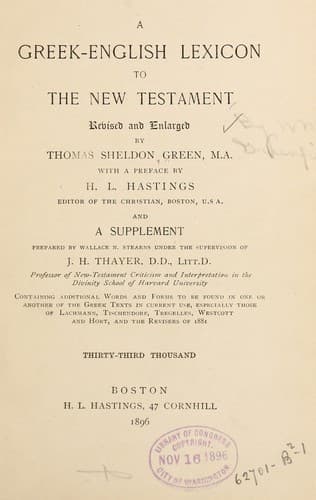
A Greek-English Lexicon to the New TestamentGreenfield, William
Religion
A Greek-English Lexicon to the New Testament
Greenfield, William
Bible. New Testament -- Dictionaries -- English; Greek language, Biblical -- Dictionaries -- English
1.18, 23; 24.19, et al.; γαστέρες, paunches, gluttons,
Tit. 1.12.
Γε,
an enclitic particle imparting emphasis; indicating that a particular
regard is to be had to the term to which it is attached. Its force is
to be conveyed, when this is possible, by various expression: at least,
indeed, even, &c.
Γέεννα, ης, ἡ, (Heb. גיא הנס)
Gehenna, pr. the valley of Hinnom south of Jerusalem, once celebrated
for the horrid worship of Moloch, & afterwards polluted with every
species of filth, as well as the carcases of animals, and dead bodies
of malefactors; to consume which, in order to avert the pestilence
which such a mass of corruption would occasion, constant fires were
kept burning; hence, hell, the fires of Tartarus, the place of
punishment in Hades, Mat. 5.22, 29, 30; 10.28; 18.9, et al. N.T.
Γείτων, ονος, ὁ, ἡ
a neighbour, Lu. 14.12; 15.6, 9. Jno. 9.8
Γελάω, ῶ,
f. άσομαι, &, later, ασω, a.1. ἐγέλασα,
to laugh, smile; by impl. to be merry, happy, to rejoice,
Lu. 6.21, 25. (ᾰ).
Γέλως, ωτος, ὁ,
laughter; by impl. mirth, joy, rejoicing, Ja. 4.9.
Γεμίζω,
f. ίσω, a.1. ἐγέμισα, a.1 pass. ἐγεμίσθην,
to fill, Mar. 4.37; 15.26, et al:
from
Γέμω,
to be full, Mat. 23.27. Lu. 11.39, et al.
Γενεά, ᾶς, ἡ,
pr. birth; hence, progeny; a generation of mankind,
Mat. 11.16; 23.36, et al.; a generation, a step in a genealogy,
Mat. 1.17; a generation, an interval of time, age; in N.T. course
of life, in respect of its events, interests, or character,
Lu. 16.8. Ac. 13.36.
Γενεαλογέω, ῶ, (γενεά & λέγω)
f. ήσω,
to reckon one's descent, derive one's origin, He. 7.6:
whence
Γενεαλογία, ας, ἡ,
genealogy, catalogue of ancestors, history of descent,
1 Ti. 1.4. Tit. 3.9.
Γενέσια, ων, τά,
pr. a day observed in memory of the dead; in N.T. equivalent
to γενέθλια, celebration of one's birth-day, birth-day festival.
Mat. 14.6. Mar. 6.21.
Γένεσις, εως, ἡ,
birth, nativity, Mat. 1.18. Lu. 1.14. Ja. 1.23; successive
generation, descent, lineage, Mat. 1.1; meton. life, Ja. 3.6.
Γενετή, ῆς, ἡ,
birth, Jno, 9.1.
Γένημα, τό,
v.r. Lu. 12.18. 2 Co. 9.10, natural produce, fruit, increase. N.T.
Γεννάω, ω,
f. ήσω, p. γεγέννηκα, a.1. ἐγέννησα, p. pass. γεγέννημαι,
a.1. pass. ἐγεννήθην,
spoken of men, to beget, generate, Mat. 1.2...16, et al.; of women,
to bring forth, bear, give birth to, Lu. 1.13, 57, et al.;
pass. to be born, produced, Mat. 2.1, 4, et al.; met. to produce,
excite, give occasion to, effect, 2 Ti. 2.23; from the Heb.
to constitute as son, to constitute as king, or as the representative
or vicegerent of God, Ac. 13.33. He. 1.5; 5.5; by impl. to be a parent
to any one; pass. to be a son or child to any one, Jno. 1.13.
1 Co. 4.15, et al.:
whence
Γέννημα, ατος, τό,
what is born or produced, offspring, progeny, brood, Mat. 3.7; 12.34,
et al.; fruit, produce, Mat. 26.29. Mar. 14.25, et al.;
fruit, increase, Lu. 12.18; 2 Co. 9.10.
Γέννησις, εως, ἡ,
birth, nativity, Mat.
Public-domain text, read in full here on John Shaqi.
Reviews
Reviews
No reviews yet
Be the first to share your thoughts on this work.
Join the Discussion
Join the discussion
Sign in to leave a comment or review.
Sign InorCreate an account