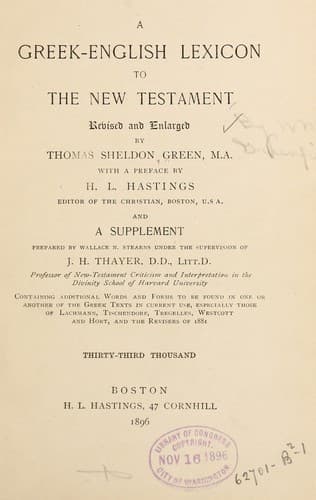
A Greek-English Lexicon to the New TestamentGreenfield, William
Religion
A Greek-English Lexicon to the New Testament
Greenfield, William
Bible. New Testament -- Dictionaries -- English; Greek language, Biblical -- Dictionaries -- English
1.18. Lu. 1.14.
Γεννητός, ή, όν,
born, or produced of, Mat. 1.18. Lu. 7.28.
Γένος, εος, τό, (γίνομαι)
offspring, progeny, Ac. 17.28, 29; family, kindred, lineage,
Ac. 7.13, et al.; race, nation, people, Mar. 7.26. Ac. 4.36. et al.;
kind, sort, species, Mat. 13.47, et al.
Γερουσία, ας, ἡ,
a senate, assembly of elders; the elders of Israel collectively,
Ac. 5.21:
from
Γέρων, οντος, ὁ,
an old man, Jno. 3.4.
Γεύομαι, (mid of γεύω, to cause to taste)
f. γεύσομαι, a.l ἐγευσάμην,
to taste, Mat. 24.34. Jno. 2.9; absol. to take food, Ac. 10.10, et al.;
met. to have perception of, experience, He. 6.4, 5. 1 Pe. 2.3;
θανάτου γεύεσθαι, to experience death, to die Mat. 16.28, et al.
Γεωργέω, ῶ, (γεωργός)
f. ήσω,
to cultivate, till the earth, He. 6.7.
Γεώργιον, οῦ, τό,
cultivated field, or ground, a farm, 1 Co. 3.9:
from
Γεωργός, οῦ, ὁ, (γῆ & ἔργον)
a husbandman, one who tills the earth, 2 Ti. 2.6. Ja. 5.7; in N.T.
spc. a vine-dresser, keeper of a vineyard, i.q. ἀμπελουργός,
Mat. 21.33, 34, et al.
Γῆ, γῆς, ἡ, (contr. fr. γέα)
earth, soil, Mat. 13.5. Mar. 4.8, et al.; the ground, surface of
the earth, Mat. 10.29. Lu. 6.49, et al.; the land, as opposed to
the sea or a lake, Lu. 5.11. Jno. 21.8, 9, 11; the earth, world,
Mat. 5.18, 35, et al.; a land, region, tract, country, territory,
Mat. 2.20; 14.34; by way of eminence, Canaan or Palestine,
Mat. 5.5; 24.30; 27.45. Ep. 6.3; the inhabitants of any region or
country, Mat. 10.15; 11.24, et al.
Γῆρας, αος, ως, τό, dat. γήραϊ, γήρᾳ, also γήρει,
old age, Lu. 1.36:
whence
Γηράσκω, v. γηράω, ω,
f. άσομαι, a.1. ἐγήρᾱσα, & ἐγήρᾱνα,
to be or become old, Jno. 21.18. He. 8.13.
Γίνομαι, (a later form of γίγνομαι)
f. γενήσομαι, p, γέγονα & γεγένημαι, a.1. ἐγενήθην, a.2. ἐγενόμην,
to come into existence; to be created, exist by creation, Jno. 1.3, 10.
He. 11.3. Ja. 3.9; to be born, produced, grow, Mat. 21.19. Jno. 8.58,
et al.; to arise, come on, occur, as the phenomena of nature, &c.;
Mat. 8.24, 26; 9.16, et al.; to come, approach, as morning or evening,
Mat. 8.16, 14.15, 23; to be appointed, constituted, established,
Mar. 2.27. Ga. 3.17, et al.; to take place, come to pass, happen,
occur, Mat. 1.22; 24.6, 20, 21, 34, et al. freq.; to be done,
performed, effected, Mat. 21.42, et al.; to be fulfilled, satisfied,
Mat. 6.10; 26.42, et al.; to come into a particular state or condition;
to become, assume the character and appearance of any thing,
Mat. 5.45; 12.45, et al.; to become or be made any thing, be changed
or converted, Mat. 4.3; 21.42. Mar. 1.17, et al.; to be, esse,
Mat. 11.26; 19.8; γίνεσθαι ὑπό τινα, to be subject to, Ga. 4.4;
γίνεσθαι ἐν ἑαυτῷ, to come to one's self, to recover from a trance
or surprise, Ac. 12.11; μὴ γένοιτο, let it not be, far be it from,
God forbid, Lu. 20.16. Ro. 3.4, 31, et al.; to be kept, celebrated,
solemnised, as festivals, Mat. 26.2, et al.; to be finished, completed,
He. 4.3.
Public-domain text, read in full here on John Shaqi.
Reviews
Reviews
No reviews yet
Be the first to share your thoughts on this work.
Join the Discussion
Join the discussion
Sign in to leave a comment or review.
Sign InorCreate an account