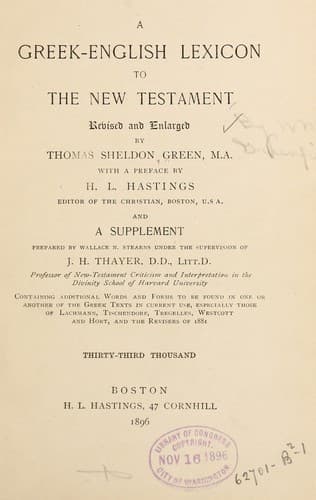
A Greek-English Lexicon to the New TestamentGreenfield, William
Religion
A Greek-English Lexicon to the New Testament
Greenfield, William
Bible. New Testament -- Dictionaries -- English; Greek language, Biblical -- Dictionaries -- English
Γῑνώσκω, (a later form of γιγνώσκω)
f. γνώσομαι, p. ἔγνωκα, a.2. ἔγνων, p. pass. ἔγνωσμαι,
a.1. pass. ἐγνώσθην,
to know, whether the action be inceptive or complete and settled;
to preceive, Mat. 22.18. Mar. 5.29; 8.17; 12.12. Lu. 8.46; to mark,
discern, Mat. 25.24. Lu. 19.44; to ascertain by examination,
Mar. 6.38. Jno. 7.51. Ac. 23.28; to understand, Mar. 4.13. Lu. 18.34.
Jno. 12.16; 13.7. Ac. 8.30, 1 Co. 14.7, 9; to acknowledge, Mat. 7.23.
2 Co. 3.2; to be resolve, conclude, Lu. 16.4. Jno. 7.26; 17.8; to be
assured, Lu. 21.20. Jno. 6.69; 8.52. 2 Pe. 1.20; to be skilled, to be
master of a thing, Mat. 16.3. Ac. 21.37; to know carnally, Mat. 1.25.
Lu. 1.34; fr. the Heb. to view with favour, 1 Co. 8.3. Gal. 4.9.
Γλεῦκος, εος, τό,
pr. the unfermented juice of grapes, must; hence, sweet new wine.
Ac. 2.13:
from
Γλῠκύς, εῖα, ύ,
sweet, Ja. 3.11, 12. Re. 10.9, 10.
Γλῶσσα, ης, ἡ,
the tongue, Mar. 7.33, 35, et al.;
meton. speech, talk, 1 Jno. 3.18;
a tongue, language, Ac. 2.11. 1 Co. 13.1, et al.;
meton. a language not proper to a speaker,
a gift or faculty of such language, Mar. 16.17. 1 Co. 14.13, 14, 26, et al.:
fr. Heb. a nation as defined by its language, Re. 5.9, et al.;
met. a tongue-shaped flame, Ac. 2.3.
Γλωσσόκομον, ου, τό, (γλῶσσα & κομέω, to keep, perserve)
pr. a box for keeping tongues, mouthpieces, or reeds, of musical
instruments; hence, genr. any box or receptacle; in N.T. a purse,
money bag. Jno. 12.6; 13.29. L.G.
Γναφεύς, έως, ὁ, (γνάφος, a teasel, or thistle)
a fuller, part of whose business was to raise a nap by meanss of
teasels, &c., Mar. 9.3.
Γνήσιος, ου, ὁ, ἡ, (γένος)
lawful, legitimate, as children; genuine, in faith, &c. 1 Ti. 1.2.
Tit. 1.4; true, sincere, 2 Co. 8.8. Phi. 4.3:
whence
Γνησίως,
adv. genuinely, sincerely, Phi. 2.20.
Γνόφος, ου, ὁ,
a thick cloud, darness, He. 12.18.
Γνώμη, ης, ἡ, (γινώσκω)
the mind, as the means of knowing and judging; various operations
of the mind, as inclination, 1 Co. 1.10;
accordance, consent, Phile. 14;
purpose, resolution, Ac. 20.3;
opinion, judgement, 1 Co. 7.25, 40. 2 Co. 8.10.
Γνωρίζω,
f. ίσω, At. ιῶ, a.1. ἐγνώρισα, a.1. pass. ἐγνωρίσθην,
to make known, reveal, declare, Jno. 15.15; 17.26, et al.;
to know, Phi. 1.22.
Γνῶσις, εως, ἡ, (γινώσκω)
knowledge, Lu. 1.77;
knowledge of an especial kind and relatively high character,
Lu. 11.52. Ro. 2.20. 1 Ti. 6.20,
more particularly in respect of Christian enlightenment,
Ro. 15.14. 1 Co. 8.10; 12.8. 2 Co. 11.6, et al.
Γνώστης, ου, ὁ, (fr. same)
one acquainted with a thing, knowing, skilful, Ac. 26.3. L.G.
Γνωστός, ή, όν, (fr. same)
known, Jno. 18.15, 16, et al.; certain, incontrovertible, Ac. 4.16;
τὸ γνωστόν, that which is known or is cognisable, the unquestionable
attributes, Ro. 1.19; subst. an acquaintance, Lu. 2.44; 23.49.
Γογγύζω,
f. ύσω, a.1. ἐγόγγυσα,
to speak privately and in a low voice, mutter, Jno. 7.32; to utter
Public-domain text, read in full here on John Shaqi.
Reviews
Reviews
No reviews yet
Be the first to share your thoughts on this work.
Join the Discussion
Join the discussion
Sign in to leave a comment or review.
Sign InorCreate an account