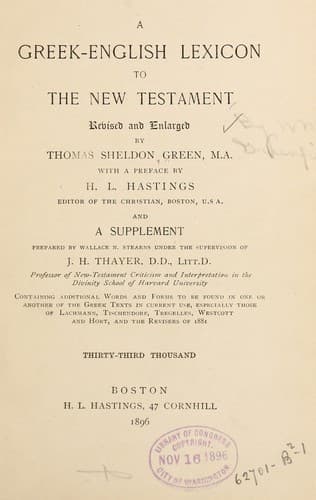
A Greek-English Lexicon to the New TestamentGreenfield, William
Religion
A Greek-English Lexicon to the New Testament
Greenfield, William
Bible. New Testament -- Dictionaries -- English; Greek language, Biblical -- Dictionaries -- English
secret and sullen discontent, express indignant complaint, murmer,
grumble, Mat. 20.11. Lu. 5.30. Jno. 6.4, 43, 61: (L.G.)
whence
Γογγυσμός, οῦ, ὁ,
a muttering, murmuring, low and suppressed discourse, Jno. 7.12;
the expression of secret and sullen discontent, murmuring, complaint,
Ac. 6.1. Phi. 2.14. 1 Pe. 4.9. L.G.
Γογγυστής, οῦ, ὁ,
a murmurer, Jude 16. L.G.
Γόης, ητος, ὁ,
a juggler, diviner; hence, by impl. an imposter, cheat, 2 Ti. 3.13.
Γόμος, ου, ὁ (γέμω)
the lading of a ship, Ac. 21.3; by impl. mechandise, Re. 18.11, 12.
Γονεύς, έως, ὁ, (γίνομαι)
a father; pl. parents, Mat. 10.21. Lu. 2.27, 41. 2 Co. 12.14.
Γόνυ, ᾰτος, τό,
the knee, Lu. 22.41. He. 12.12, et al.
Γονυπετέω, ῶ, (γόνυ & πίπτω)
f. ήσω, a.1. ἐγανυπέτησα,
to fall upon one's knees, to kneel before, Mat. 17.14; 27.29.
Mar. 1.40; 10.17.
Γράμμα, ᾰτος, τό, (γράφω)
pr. that which is written or drawn; a letter, character of the
alphabet, Lu. 23.38; a writing, book, Jno. 5.47; an acknowledgement
of debt, an account, a bill, note, Lu. 16.6, 7; an epistle, letter,
Ac. 28.21. Ga. 6.11; ἱερὰ γράμματα, Holy writ, the sacred books of
the Old Testament, the Jewish Scriptures, 2 Ti. 3.15; spc. the
letter of the law of Moses, i.e. the bare literal sense,
Ro. 2.27, 29. 2 Co. 3.6, 7; pl. letters, learning, Jno. 7.15.
Ac. 26.24:
whence
Γραμμᾰτεύς, εως, ὁ,
a scribe, a clerk, town-clerk, register, recorder, Ac. 19.35;
one skilled in the Jewish law, a teacher or interpreter of the
law, Mat. 2.4; 5.20, et al. freq.; genr. a religious teacher,
Mat. 13.52; by synecd. any one distinguished for learning or
wisdom, 1 Co. 1.20.
Γραπτός, ή, όν, (γράφω)
written, Ro. 2.15.
Γραφή, ῆς, ἡ,
a writing; in N.T. the Holy Scriptures, the Jewish Scriptures
or books of the Old Testament, Mat. 21.42. Jno. 5.39, et al.;
by synecd. doctrines, declarations, oracles, or promises contained
in the sacred books, Mat. 22.29. Mar. 12.24, et al.; spc. a
prophecy, Mat. 36.54. Mar. 14.49. Lu. 4.21; 24.27, 32; with
the addition of προφητική, Ro. 16.26, of τῶν προφητῶν, Mat. 26.56:
from
Γράφω,
f. ψω, p. γέγρᾰφα, a.1. ἔγραψα,
to engrave, write, according to the ancient method of writing on
plates of metal, waxed tables, &c. Jno. 8.6, 8; to write on parchment,
paper, &c. generally, Mat. 27.37, et al.; to write lettrs to another,
Ac. 23.25. 2 Co. 2.9; 13.10, et al.; to describe in writing, Jno. 1.46.
Ro. 10.5; to inscribe in a catalogue, &c. Lu. 10.20. Re. 13.8; 17.8,
et al.; to write or impose a law, command or enact in writing,
Mar. 10.5; 12.19. Lu. 2.23, et al.
Γραώδης, εος, ὁ, ἡ, τό, -ες, (γραῦς, an old woman)
old-womanish; by impl. silly, absurd, 1 Ti. 4.7. L.G.
Γρηγορέω, ῶ, (a later form from the perf. ἐγρηγορα)
f. ήσω, a.1. ἐγρηγόρησα,
to be awake, to watch, Mat. 26.38, 40, 41. Mar. 14.34, 37, 38;
to be alive, 1 Thes. 5.10; met. to be watchful, attentive, vigilant,
circumspect, Mat. 25.13. Mar. 13.35, et al.
Γυμνάζω, (γυμνός)
f.
Public-domain text, read in full here on John Shaqi.
Reviews
Reviews
No reviews yet
Be the first to share your thoughts on this work.
Join the Discussion
Join the discussion
Sign in to leave a comment or review.
Sign InorCreate an account